Home › Our equipment › Cereals & Fruit
Drying, hulling, milling, processing the surplus
Post-harvest losses concentrate a considerable share of the value lost by staple and fruit sectors. Insufficient drying, damp storage, no processing equipment at the production peak: the causes are technical and are addressed with equipment.
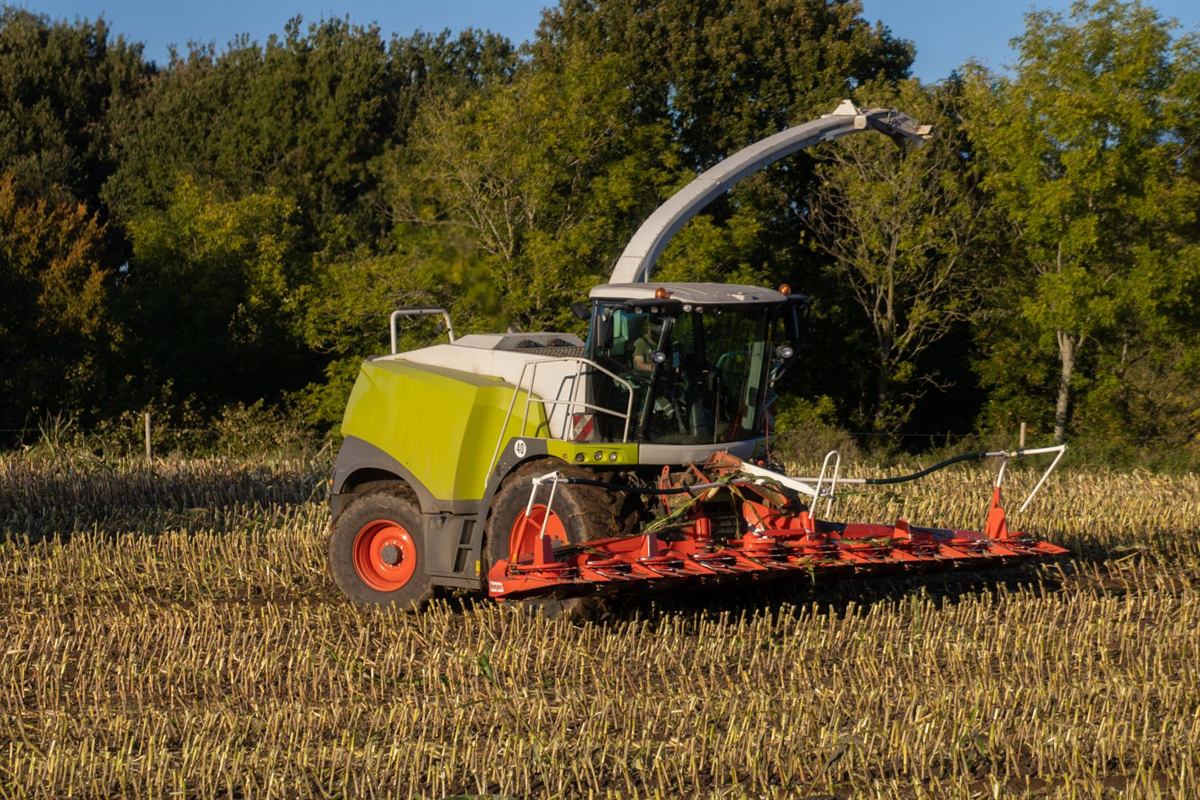
Two distinct problems, one industrial answer
For cereals and pulses the problem is storage. Grain harvested above 14 % moisture enters the water activity range where moulds and insects develop, with a risk of mycotoxin contamination that makes the batch unfit for consumption. Bringing moisture down to 12-13 % and holding it there through storage is the most effective and least costly measure for protecting the harvest.
For fruit the problem is seasonality. Production concentrates into a few weeks during which prices collapse and unsold fruit rots, then disappears from the market for the rest of the year. Processing — drying, purée, pasteurised juice — moves value through time. It does, however, require rigorous process hygiene and a strict heat treatment schedule: an insufficiently pasteurised juice is a dangerous product.
In both cases the classic mistake is oversizing. A dryer or a juice line planned for the harvest peak sits idle the rest of the year. Design should seek versatility — the same trays for several products, the same tanks for several recipes — and the sequencing of campaigns.
Storage moisture
12 to 13 % for most cereals; above 14 %, fungal risk becomes significant.
Fruit drying
Generally 50 to 65 °C; above that, vitamin degradation and browning.
Juice pasteurisation
Schedule of the order of 85 to 95 °C, duration matched to product acidity.
Milling
Target particle size depends on the use: bread flour, semolina, animal feed.
Usual technological reference points; heat treatment schedules must be validated product by product, in line with the applicable food safety requirements.
Two typical chains: grain on one side, fruit on the other
The stations below describe the cereal chain; the fruit chain (washing, destoning, crushing, refining, pasteurising, hot filling) follows the same logic of progressive reduction then stabilisation.
Threshing and winnowing
Separation of grain from straw or ear by a tooth or bar thresher, followed by air cleaning separating light impurities by their difference in terminal settling velocity.
Operating parameters
- Throughput 0.5 to 3 t/h
- Threshing losses target < 2 %
- Adjustment rotor speed and concave
Drying
Thin-layer drying in a tunnel, tray or column dryer with indirect hot air. The thermal gradient must stay moderate to avoid cracking the grain.
Operating parameters
- Air temperature 45 to 60 °C (grain)
- Final moisture 12 to 13 %
- Heating indirect, exchanger
Cleaning and grading
Screening, aspiration and densimetric separation removing stones, dust, shrivelled grain and foreign seeds before hulling or milling.
Operating parameters
- Residual impurities target < 1 %
- Stages screens + aspiration + density
- Throughput 0.5 to 3 t/h
Hulling and whitening
Hulling by differential-speed rubber rollers for rice, or by abrasive discs for other grains, followed by whitening and polishing according to the target product.
Operating parameters
- Broken grain to minimise
- Degree of whitening adjustable
- By-products usable brans
Milling
Grinding by hammer or stone mill, with particle size set by the screen fitted, dust extraction and control of flour heating.
Operating parameters
- Throughput 100 kg/h to 2 t/h
- Screens 0.5 to 3 mm interchangeable
- Power 5.5 to 37 kW
Packing and storage
Weighing, bagging and storage in a ventilated room on pallets, with monitoring of batch moisture and temperature over time.
Operating parameters
- Packing bags, big bags, silos
- Monitoring moisture and temperature
- Protection against insects and rodents
The ranges given are orders of magnitude for design drawn from process practice; they are adjusted for each installation once the raw material actually processed has been characterised.
12 machines in the catalogue
Each machine has its own detailed sheet: role in the process chain, operating principle, indicative specifications, installation requirements, maintenance and a direct quotation request.
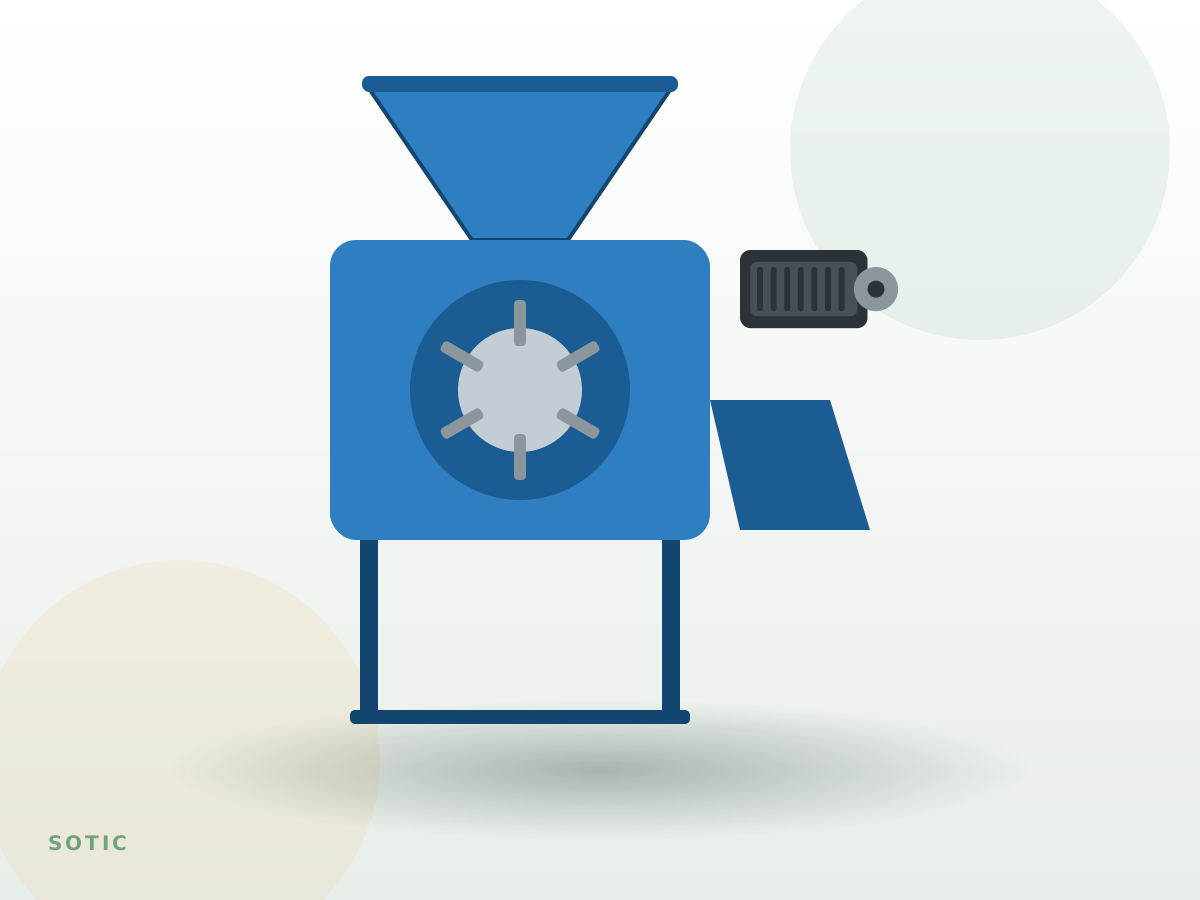
Dry hammer mill
Grinds dry products by impact, with particle size set by the screen fitted.
View the sheet
Wet paste mill
Wet grinding of pasty products, with an inclined feed chute.
View the sheet
Parabolic solar dryer
Solar dryer with parabolic reflector: concentrated radiation, no energy consumption.
View the sheet
Gas roaster
Rotating drum roasting with flame control and a mastered treatment curve.
View the sheet
Cereal mill
Fine grinding of cereals in stainless steel, for flour intended for human consumption.
View the sheet
Smokehouse
Hot or cold smoking in a controlled enclosure, for fish, meat and processed products.
View the sheet
Drum roaster
Versatile drum roaster for groundnuts, seeds and cereals.
View the sheet
Weighing and bagging machine
Automated weight dosing and bag filling, for a weight that matches the declared unit.
View the sheet
Fruit press
Juice extraction by stainless steel screw pressing, with continuous pomace discharge.
View the sheet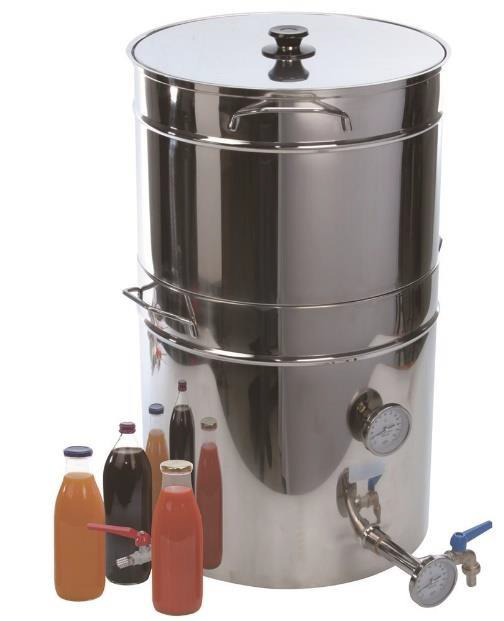
Pasteuriser
Controlled heat treatment: the stage that makes juice safe and stable.
View the sheet
Stainless steel tank
Buffer storage, maturation and preparation in food-grade stainless steel.
View the sheet
Semi-automatic bottling machine
Constant-volume filling and hot bottling, at the end of the juice line.
View the sheetGrain and fruit processing stations
The equipment is designed to be run by versatile operators, with accessible, documented settings and wear parts replaceable without stripping the whole machine.
Thresher-winnower
Tooth or bar rotor, adjustable concave, interchangeable screens and a cleaning fan with air flow adjusted to grain density.
- Throughput 0.5 to 3 t/h
- Power 7.5 to 22 kW
- Settings rotor, concave, air
- Drive engine or power take-off
Modular tunnel dryer
Tray or trolley modules, indirect hot air generator, forced ventilation and partial air recirculation, suited to grain and cut fruit alike.
- Capacity 200 to 2,000 kg/batch
- Temperature 40 to 80 °C
- Energy gas, biomass or electric
- Versatility grain and fruit
Cleaner-separator
Combination of vibrating screens, aspiration and densimetric separation for removing impurities before processing.
- Throughput 0.5 to 3 t/h
- Power 1.5 to 5.5 kW
- Fractions 3 to 4 outlets
- Screens interchangeable
Roller huller
Differential-speed rubber rollers with adjustable gap, husk separator and recycling of unhulled grain.
- Throughput 300 kg/h to 2 t/h
- Power 5.5 to 18.5 kW
- Rollers replaceable
- Broken grain minimised by setting
Hammer mill
Rotor with reversible hammers, interchangeable screens determining particle size, integrated aspiration and rate-regulated hopper.
- Throughput 100 kg/h to 2 t/h
- Power 5.5 to 37 kW
- Screens 0.5 to 3 mm
- Hammers reversible, 4 positions
Fruit washing and preparation line
Bubble washing tank, sorting conveyor, trimming and destoning stations, stainless work surfaces and organised waste removal.
- Throughput 200 kg/h to 1.5 t/h
- Water partial recycling possible
- Contact AISI 304 stainless
- Stations ergonomic
Crusher-refiner (pulper)
Crushing then refining on a fine screen separating pulp from skins and seeds, with fineness adjusted to the target product.
- Throughput 200 kg/h to 1.5 t/h
- Screens 0.6 to 1.2 mm
- Power 3 to 11 kW
- Outlets pulp / waste
Pasteuriser and filler
Tubular exchanger or jacketed vessel with control and recording of the schedule, followed by hot filling and controlled cooling.
- Schedule 85 to 95 °C, set duration
- Recording of the time-temperature pair
- Filling hot
- Contact AISI 304 stainless
Silos and handling
Storage cells, bucket elevators, transfer screws and discharge hoppers, with sampling points for batch control.
- Capacity made to measure
- Handling elevators, screws
- Control organised sampling
- Ventilation by product stored
The stations described above complement the catalogue machines: they are studied, adapted or manufactured on request according to the configuration of your line. The values shown are usual design ranges for this type of equipment; contractual characteristics are established project by project by the SOTIC design office and are not a commitment at this stage.
What separates storing from losing
Post-harvest losses are not a climatic inevitability: they are measurable physical parameters on which equipment acts directly.
Moisture control
Measure moisture at the entrance to storage, not only at the dryer outlet. An uneven batch re-equilibrates during storage and creates risk zones even if the average is correct.
Mycotoxin prevention
Rapid drying after harvest, removal of broken and mouldy grain, cleaning of cells between seasons: three actions that greatly reduce the health risk.
Milling consistency
A constant particle size governs the technological suitability of the flour and customer satisfaction. It comes from controlling hammer wear and screen condition.
Pasteurisation schedule
A recorded time-temperature pair matched to product acidity, and hot filling with seal checking: these three elements govern the safety of the juice produced.
The machine alone is not enough
Every cereals and fruit project is treated as a whole: study, manufacturing, host building, commissioning, training and maintenance.
Sizing
Material and energy balance, process selection, target throughput, investment estimate and operating cost per tonne.
WORKSCivil engineering
Anchor blocks, slabs, effluent drainage, ventilation, separation of clean and dirty areas, electrical supply.
TRAININGLine operation
Operator training in settings, in-process quality checks and emergency stop procedures.
SERVICEMaintenance
Preventive maintenance plan, set of wear parts, corrective work and locally sourced spares.
cereals and fruit: what to check before investing
It is often the only economically viable configuration, given seasonality. Versatility is designed upstream: trays and trolleys shared between products, tanks cleanable between recipes, interchangeable screens, campaigns sequenced to avoid overlaps. Two limits must be respected: strict separation of allergens, and complete cleaning between products with a strong aromatic footprint.
The direct solar dryer is inexpensive but slow, weather-dependent, and exposes the product to dust and insects if not properly sheltered. The mixed dryer — solar collector with thermal back-up, trays in a closed enclosure — offers the best compromise for marketable production: regulated temperature, food safety protection, guaranteed capacity in the wet season. For export production, a closed enclosure with filtered air becomes a requirement, not an option.
It follows from the intended use. Bread flour requires a fine, regular grind; maize semolina calls for a larger size with a controlled proportion of fines; animal feed tolerates a coarser grind, better used by the animal's digestion. A hammer mill with a set of interchangeable screens covers those three uses on one machine, provided the power has been sized for the finest grind.
Process your surplus instead of losing it
Products to be processed, volumes per season, harvest calendar and commercial destination: these elements let us propose a properly sized, versatile unit.