Home › Our equipment › Cereals & Fruit › Stainless steel tank
Stainless steel tank
Buffer storage, maturation and preparation in food-grade stainless steel.
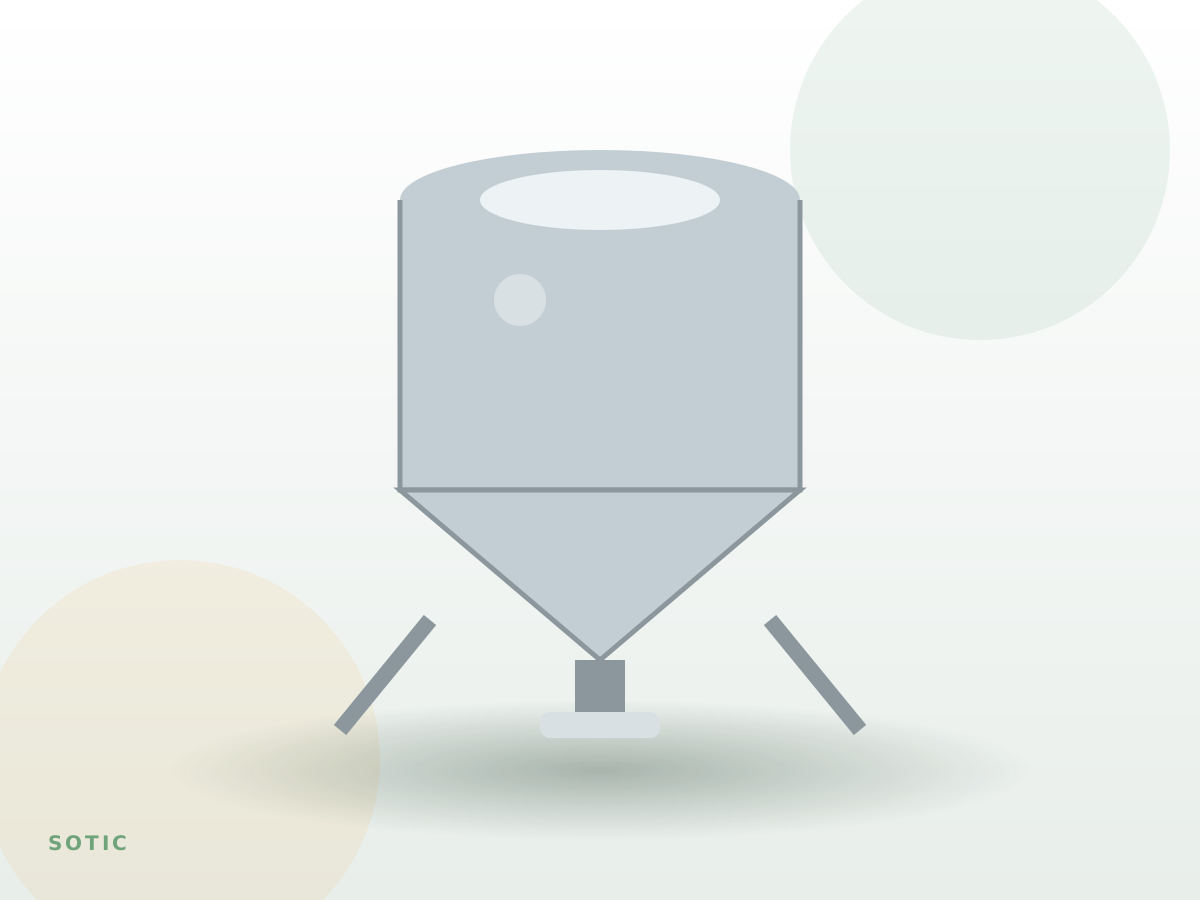
What this machine does
Tanks perform the least spectacular and most structuring function in a workshop: decoupling the stations. Without a buffer volume, every machine has to run at exactly the rhythm of the one before; the slightest stoppage propagates immediately along the whole line. A well-placed tank absorbs those variations and lets each station work at its own optimum rate.
They also serve as preparation volumes: mixing, acidity correction, resting, settling, maturation. Their design determines how cleanable they are — and therefore the food safety of the production. The critical points are known: radiused rather than sharp corners, no retention zones where product stagnates, a bottom sloping to a full-drain valve, and polished welds. A tank that does not empty completely keeps a residue that contaminates the next run.
See the sector Cereals & FruitAt a glance
- ReferenceFRU-CUV
- SectorCereals & Fruit
- PurposeBuffer storage, maturation and preparation in food-grade stainless steel.
A detailed PDF data sheet will be available in the document centre once produced.
The parts that do the work
Stainless cylindrical body
Storage volume with smooth walls and polished welds, with no retention zones.
Sloping bottom
Geometry ensuring complete gravity draining, with no residue at the bottom.
Drain valve
Removable, cleanable fitting with no dead volume upstream of the seat.
Accessories
Lid, manway, level indicator, agitation or coil according to the intended use.
Technical data and configurations
| Characteristic | Indicative value |
|---|---|
| Volume | made to measure according to use and line |
| Material | food-grade AISI 304 stainless steel |
| Finish | polished welds, radiused corners |
| Bottom | sloping to full drain |
| Options | agitation, heating or cooling coil, insulation |
| Access | lid or manway for cleaning |
| Supports | adjustable feet or frame |
| Cleaning | manual or by spray ball according to configuration |
These are usual design ranges for this type of machine, intended to guide early thinking. The contractual characteristics of the equipment actually manufactured — throughputs measured at acceptance, absorbed power, real footprint and weight — are established by the SOTIC design office and stated in the technical offer.
Available configurations
- Plain storage tanks or tanks fitted with agitation and temperature control.
- Insulated version for holding temperature or chilled storage.
- Clean-in-place equipment for the most demanding workshops.
Installation requirements
- Flat floor and adjustable supports allowing levelling and complete draining.
- Height allowing gravity transfer to the downstream station where possible.
- Clearance around the tank for external cleaning and valve access.
- Floor drainage nearby for washing operations.
Maintenance and safety at the workstation
A machine lasts as long as its maintenance does. The points below appear in the preventive maintenance plan handed over at acceptance and are covered during operator training.
Preventive maintenance
- Cleaning and disinfection after every production run, with the valve dismantled.
- Check the stainless steel surface condition: any deep scratch becomes a microbial retention point.
- Check valve and manway gaskets.
- Inspect the welds and treat any start of corrosion immediately.
Safety
- Never enter a tank without a confined-space procedure and external supervision.
- Beware of cleaning products: the alkaline and acid solutions used are corrosive.
- Check there is no vacuum before opening a closed tank after draining.
Before ordering this machine
The volume of a buffer tank is calculated from the throughput of the upstream station and the length of the stoppages it must absorb. Too small and it does not decouple; too large and it lengthens the product's residence time, which is not neutral for juices sensitive to oxidation. This sizing is part of the line study.
AISI 304 suits the great majority of food applications. AISI 316, which contains molybdenum, resists chloride environments and certain acids better: it is justified for particularly aggressive products or in a saline atmosphere. The extra cost is only relevant if the product genuinely requires it; we state that choice case by case.
Request a quote: Stainless steel tank
Tell us the throughput you are aiming for, the material to be processed and the energy available on your site: we come back with a reasoned configuration and a price, rather than a catalogue rate.
- Technical answer: we first check that this machine genuinely matches your need.
- Tailored configuration: size, drive, options and wear parts defined with you.
- Complete pricing: equipment, transport, erection, commissioning and training.
- Next steps: civil works, connections and maintenance where required.
First reply target: 48 working hours.
Other machines in the Cereals & Fruit
Dry hammer mill
Grinds dry products by impact, with particle size set by the screen fitted.

Wet paste mill
Wet grinding of pasty products, with an inclined feed chute.

Parabolic solar dryer
Solar dryer with parabolic reflector: concentrated radiation, no energy consumption.

Gas roaster
Rotating drum roasting with flame control and a mastered treatment curve.