Home › Our equipment › Cereals & Fruit › Dry hammer mill
Dry hammer mill
Grinds dry products by impact, with particle size set by the screen fitted.
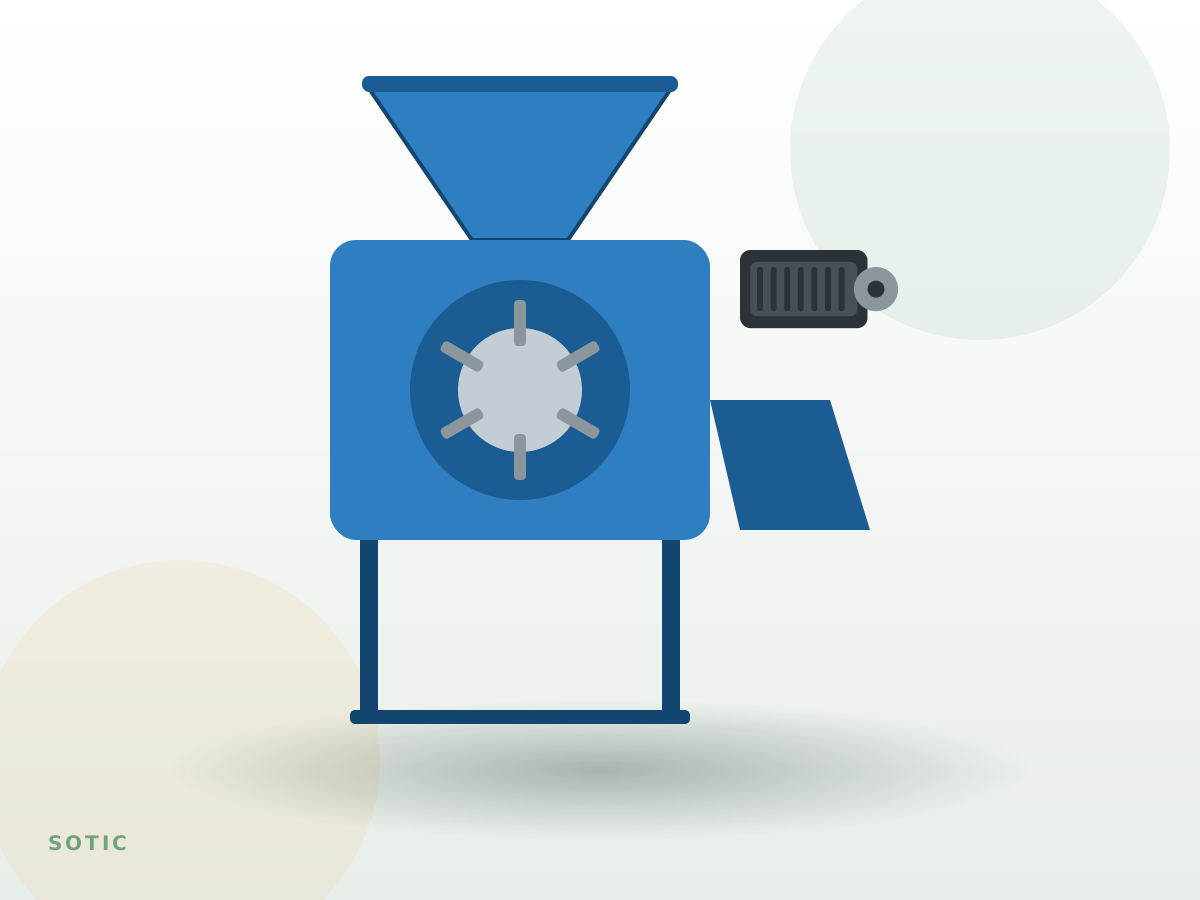
What this machine does
The dry mill reduces dehydrated products — cereals, cassava chips, pulses, spices — by the impact of hammers turning at high speed inside a chamber fitted with a screen. A particle is only discharged once it has become fine enough to pass the mesh: it is therefore the screen, not the rotor speed, that sets the maximum particle size of the product leaving the mill.
Grinding dry products calls for a specific energy well above that of wet grinding, and that energy rises steeply as the fineness sought increases: producing bread flour costs appreciably more per tonne than producing animal feed. Two practical consequences follow: the motor must be sized on the finest grind envisaged, and extraction must be planned from installation, dry grinding generating fine dust that is at once a nuisance, a material loss and a hazard.
See the sector Cereals & FruitAt a glance
- ReferenceCER-BAS
- SectorCereals & Fruit
- PurposeGrinds dry products by impact, with particle size set by the screen fitted.
A detailed PDF data sheet will be available in the document centre once produced.
The parts that do the work
Rotor with reversible hammers
Hammers mounted on pins, reversible so all four edges can be used before replacement.
Interchangeable screen
Mesh determining the outlet particle size, changed according to the product made.
Rate-regulated hopper
Steady feed avoiding the overloads that pull down speed and fineness.
Extraction and cyclone
Captures fines, reduces dust in the room and recovers product.
Technical data and configurations
| Characteristic | Indicative value |
|---|---|
| Indicative throughput | 100 kg/h to 2 t/h depending on product and fineness |
| Installed power | 5.5 to 37 kW |
| Screens | 0.5 to 3 mm, interchangeable |
| Hammers | reversible, four wear positions |
| Power supply | Three-phase 380 V — 50 Hz |
| Extraction | cyclone recommended, mandatory in a closed room |
| Contact materials | treated steel and stainless steel by component |
| Safety | interlocked cover, protective magnet recommended |
These are usual design ranges for this type of machine, intended to guide early thinking. The contractual characteristics of the equipment actually manufactured — throughputs measured at acceptance, absorbed power, real footprint and weight — are established by the SOTIC design office and stated in the technical offer.
Available configurations
- Complete screen sets according to the range of products made.
- Version with integrated extraction and cyclone.
- Manual feeding or metering screw.
Installation requirements
- Rigid anchored block or slab: vibration is permanent.
- Extraction connected, with the cyclone preferably sited outside the room.
- Electrical supply sized on installed power, not on absorbed power.
- Sufficient clearance to open the cover and change the screen.
Maintenance and safety at the workstation
A machine lasts as long as its maintenance does. The points below appear in the preventive maintenance plan handed over at acceptance and are covered during operator training.
Preventive maintenance
- Check hammer wear and turn them as each edge dulls.
- Inspect the screen: a torn mesh lets coarse particles through with no warning.
- Clean the cyclone and the extraction ducts.
- Check rotor balance after any hammer replacement — as a complete set, never individually.
Safety
- Dust fire and explosion risk: eliminate ignition sources and keep extraction running.
- Magnet or detector upstream: a metallic foreign body in the chamber causes sparks and destroys the rotor.
- Electrical isolation before opening the cover.
Before ordering this machine
It follows from the intended use. Bread flour requires a fine, regular grind; maize semolina calls for a coarser size with a controlled proportion of fines; animal feed tolerates coarser particles, which are better used by the animal's digestion. A set of interchangeable screens covers these three uses on one machine, provided the power has been sized on the finest grind.
Almost always because of hammer wear, whose edges dull and strike less effectively, or a partly blinded screen. Both drifts are gradual and therefore barely perceptible day to day: recording actual throughput periodically allows them to be caught before they weigh on production.
Request a quote: Dry hammer mill
Tell us the throughput you are aiming for, the material to be processed and the energy available on your site: we come back with a reasoned configuration and a price, rather than a catalogue rate.
- Technical answer: we first check that this machine genuinely matches your need.
- Tailored configuration: size, drive, options and wear parts defined with you.
- Complete pricing: equipment, transport, erection, commissioning and training.
- Next steps: civil works, connections and maintenance where required.
First reply target: 48 working hours.
Other machines in the Cereals & Fruit

Wet paste mill
Wet grinding of pasty products, with an inclined feed chute.

Parabolic solar dryer
Solar dryer with parabolic reflector: concentrated radiation, no energy consumption.
Gas roaster
Rotating drum roasting with flame control and a mastered treatment curve.
Cereal mill
Fine grinding of cereals in stainless steel, for flour intended for human consumption.