Home › Our equipment › Cereals & Fruit › Fruit press
Fruit press
Juice extraction by stainless steel screw pressing, with continuous pomace discharge.
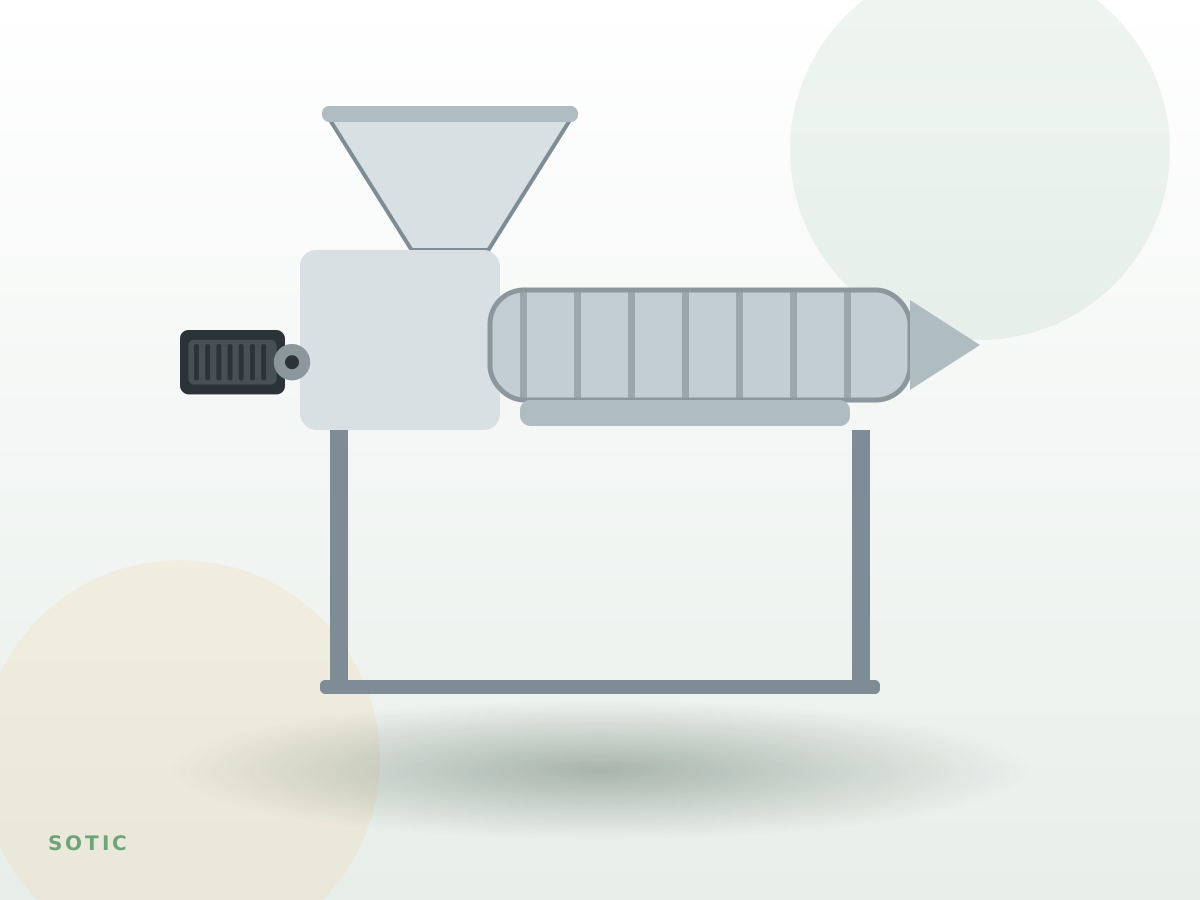
What this machine does
The fruit press separates the liquid phase from the solid phase of a crushed pulp. A reducing-pitch screw advances the material inside a cylindrical screen: the juice passes through the perforated wall and the pomace is discharged at the end of the screw. Extraction yield depends first on upstream preparation — a properly crushed fruit, possibly treated to break down pectins, releases far more juice than a coarse pulp.
The design must answer two constraints specific to fruit. The acidity of many juices requires stainless steel in contact throughout the circuit, on pain of corrosion and metallic taints. Oxidation is the second: juice left in the air browns and loses nutritional quality within tens of minutes. The circuit must therefore be arranged so the juice passes without waiting from pressing to heat treatment.
See the sector Cereals & FruitAt a glance
- ReferenceFRU-PRE
- SectorCereals & Fruit
- PurposeJuice extraction by stainless steel screw pressing, with continuous pomace discharge.
A detailed PDF data sheet will be available in the document centre once produced.
The parts that do the work
Extraction screw
Progressive compression of the pulp along the screen, with continuous pomace discharge.
Cylindrical screen
Calibrated perforations retaining solids and letting the juice through.
Counter-pressure adjustment
Balances extraction rate against the turbidity of the juice obtained.
Stainless collection
Tank and circuit in stainless steel, directing the juice without delay to the next station.
Technical data and configurations
| Characteristic | Indicative value |
|---|---|
| Indicative throughput | 200 kg/h to 1.5 t/h of pulp |
| Installed power | 3 to 11 kW |
| Product contact materials | AISI 304 stainless steel throughout |
| Adjustment | adjustable counter-pressure |
| Outlets | juice / pomace separated |
| Cleaning | screen removable without special tooling |
| Power supply | Three-phase 380 V — 50 Hz |
| Downstream | direct transfer to pasteurisation |
These are usual design ranges for this type of machine, intended to guide early thinking. The contractual characteristics of the equipment actually manufactured — throughputs measured at acceptance, absorbed power, real footprint and weight — are established by the SOTIC design office and stated in the technical offer.
Available configurations
- Several capacities according to daily output.
- Screens of different perforation according to the fruit and the clarity sought.
- Paired with an upstream crusher-refiner for dense-pulp fruit.
Installation requirements
- Room with controlled conditions, in the clean area of the workshop.
- Washable floor with fall and drainage: juices are acidic and sticky.
- Layout allowing immediate transfer of the juice to pasteurisation.
- Hot water point nearby for end-of-shift cleaning.
Maintenance and safety at the workstation
A machine lasts as long as its maintenance does. The points below appear in the preventive maintenance plan handed over at acceptance and are covered during operator training.
Preventive maintenance
- Full daily cleaning with the screen removed: pulp residues ferment quickly.
- Check wear of the screw and the screen.
- Check gaskets and the shaft passage.
- Check the surface condition of the stainless steel and treat any start of corrosion.
Safety
- Never put a hand into the hopper while running.
- Isolation before removing the screen.
- Slippery floor: clean up juice splashes immediately.
Before ordering this machine
By working upstream rather than on the press. Crushing matched to the fruit, and for some fruits an enzymatic treatment that breaks down pectins, appreciably increases the juice released. Tightening the counter-pressure raises yield marginally but pushes more fine particles into the juice, which complicates downstream clarification.
Depending on the fruit it can be used in animal feed, in compost, or for extracting compounds of interest such as pectins or fibres. What must not happen is for it to accumulate in the workshop: laden with sugars, it ferments within hours and attracts insects. Its removal must be organised when the station is designed.
Request a quote: Fruit press
Tell us the throughput you are aiming for, the material to be processed and the energy available on your site: we come back with a reasoned configuration and a price, rather than a catalogue rate.
- Technical answer: we first check that this machine genuinely matches your need.
- Tailored configuration: size, drive, options and wear parts defined with you.
- Complete pricing: equipment, transport, erection, commissioning and training.
- Next steps: civil works, connections and maintenance where required.
First reply target: 48 working hours.
Other machines in the Cereals & Fruit
Dry hammer mill
Grinds dry products by impact, with particle size set by the screen fitted.

Wet paste mill
Wet grinding of pasty products, with an inclined feed chute.

Parabolic solar dryer
Solar dryer with parabolic reflector: concentrated radiation, no energy consumption.
Gas roaster
Rotating drum roasting with flame control and a mastered treatment curve.