Home › Our equipment › Oil palm
Extracting more oil, and a less acidic oil
In a palm oil mill two figures sum up performance: the extraction rate, which measures the oil recovered against the mass of bunches processed, and oleic acidity, which governs quality and selling price. Both are decided in the first hours after cutting.
The lipase works against you from the moment the bunch is cut
The mesocarp of the palm fruit contains an endogenous lipase which, as soon as the fruit is bruised or detached, hydrolyses the triglycerides and releases free fatty acids. Oil acidity then rises hour by hour. This is the reason for steam sterilisation: to bring the mass quickly to a temperature that denatures the enzyme. A bunch processed twenty-four hours after cutting gives appreciably more acidic oil than one processed the same day, whatever the quality of the press.
Sterilisation plays three other roles at once: it eases the detachment of fruit from the stalk, softens the mesocarp and prepares the rupture of the oil-bearing cells, and begins conditioning the nuts for the kernel line. Its conduct — pressure, duration, successive air purges — is therefore a central process parameter, not a mere preliminary.
Pressing, in turn, is a constant trade-off. High counter-pressure raises the extraction rate but increases nut breakage, which sends broken kernels into the oil circuit and degrades quality; low counter-pressure protects the nuts but leaves oil in the cake. The optimum setting is found in operation, on the real material, and must be revisited according to the ripeness of the bunches received.
Cut-to-processing delay
Target: processing within 24 hours of harvest to limit acidity.
Sterilisation
Saturated steam, of the order of 2.5 to 3 bar, 60 to 90 minutes with air purges.
Extraction rate
Target order of magnitude 18 to 22 % according to bunch quality and ripeness.
Oleic acidity
Target below 5 % for standard marketable oil.
Reference values for palm oil milling; contractual targets are set with the client according to their market and the quality of the bunches supplied.
From bunch to clarified oil, and from nut to kernel
A mill in fact comprises two lines that part company after pressing: the oil line, running to clarification and drying, and the kernel line, processing the nuts recovered from the cake.
Reception and sterilisation
Weighing, ripeness inspection and loading of bunches into the steriliser. Successive air purges are essential: a pocket of air in the vessel creates a cold zone where the lipase survives.
Operating parameters
- Pressure 2.5 to 3 bar (saturated steam)
- Duration 60 to 90 min
- Purges successive cycles
Stripping
Separation of fruit and empty bunches in a rotating barred drum. The empty bunches, rich in potash, go to agronomic or energy recovery.
Operating parameters
- Fruit left on bunches target minimal
- Drum speed adjustable
- Bunch recovery compost or fuel
Digestion
Heated mixing of the fruit to break down the mesocarp and rupture the oil-bearing cells, the condition of effective pressing. Holding the temperature is decisive.
Operating parameters
- Temperature ≈ 95 to 100 °C
- Residence time 15 to 25 min
- Heating direct steam or jacket
Pressing
Extraction by screw press with adjustable counter-pressure cone. The setting balances residual oil in the cake against the proportion of broken nuts in the circuit.
Operating parameters
- Residual oil in cake to minimise
- Broken nuts to limit
- Counter-pressure adjustable while running
Clarification and drying
Static or dynamic settling of the crude oil, sludge separation, then vacuum drying to lower residual moisture and stabilise the oil in storage.
Operating parameters
- Settling temperature ≈ 90 to 95 °C
- Final moisture < 0.15 % target
- Sludge recovery of residual oil
Palm kernel processing
Separation of fibre and nuts, nut cracking, shell-kernel separation by air or water, then drying and pressing or shipment of the kernels.
Operating parameters
- Cracking controlled breakage
- Separation pneumatic or hydraulic
- Kernel drying before storage
The ranges given are orders of magnitude for design drawn from process practice; they are adjusted for each installation once the raw material actually processed has been characterised.
10 machines in the catalogue
Each machine has its own detailed sheet: role in the process chain, operating principle, indicative specifications, installation requirements, maintenance and a direct quotation request.

Bunch steriliser
Steam treatment of bunches: the operation that sets the acidity of the entire production.
View the sheet
Bunch stripper
Separates fruit from empty bunches after sterilisation, in a rotating barred drum.
View the sheet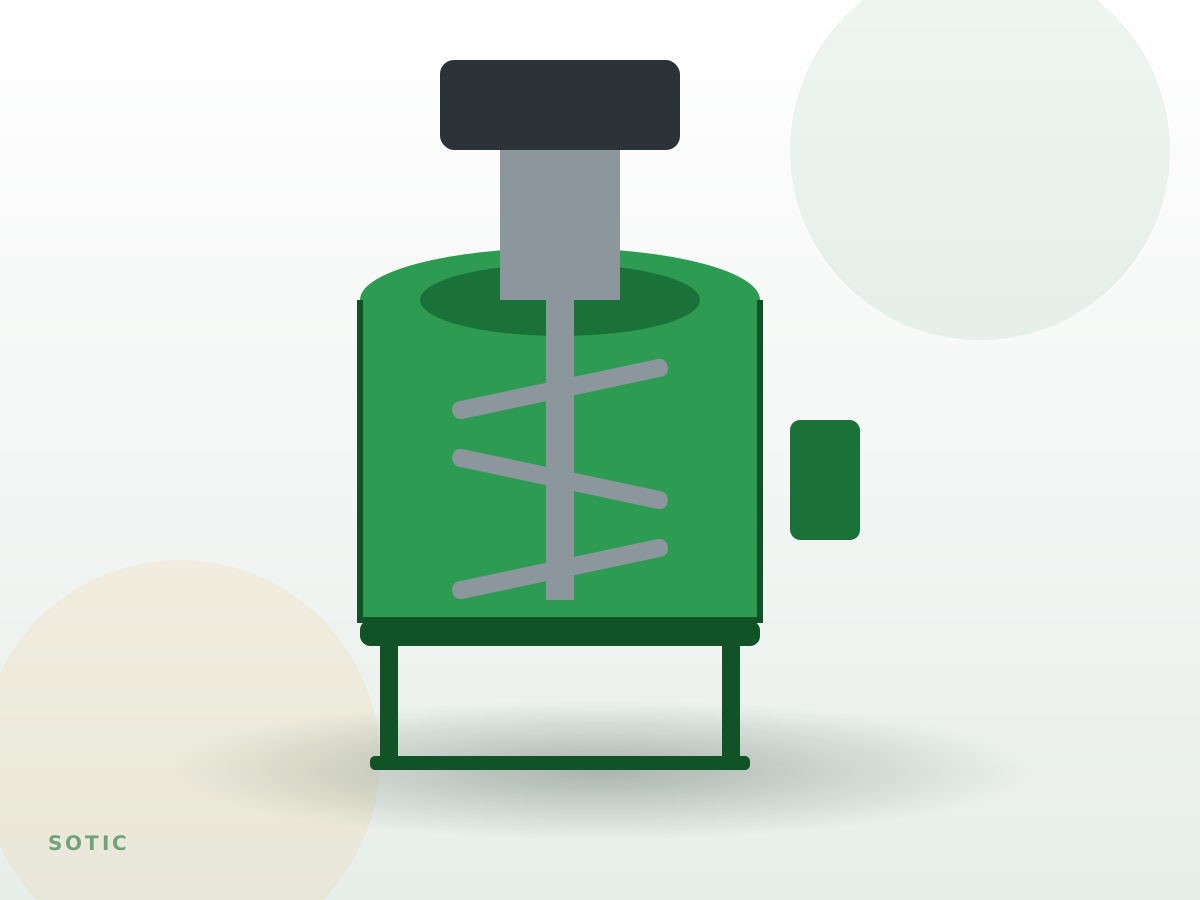
Palm fruit digester
Heated mixing that breaks down the mesocarp and ruptures the oil-bearing cells.
View the sheet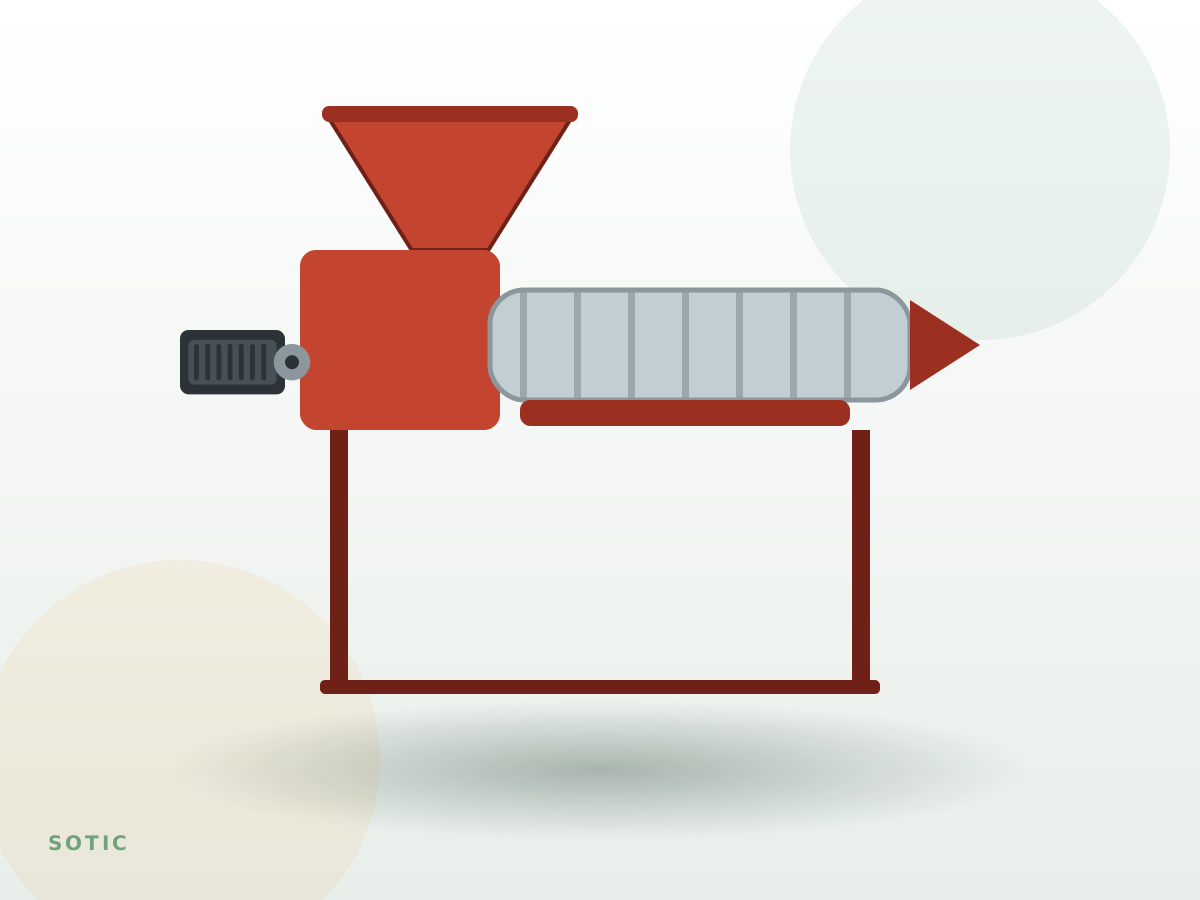
Palm oil press
Mechanical extraction by reducing-pitch screw, with counter-pressure adjustable while running.
View the sheet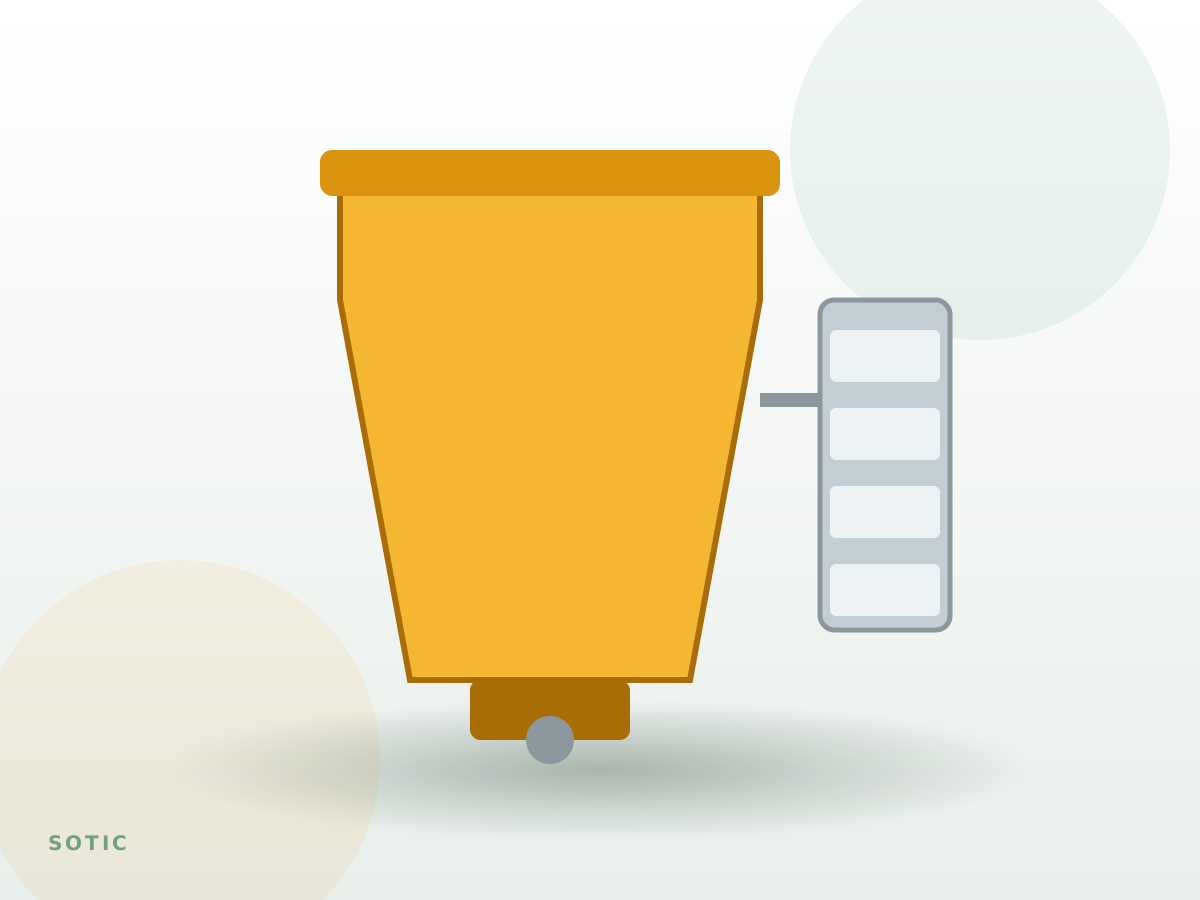
Oil filter
Clarifies crude oil by filtration, before storage or refining.
View the sheet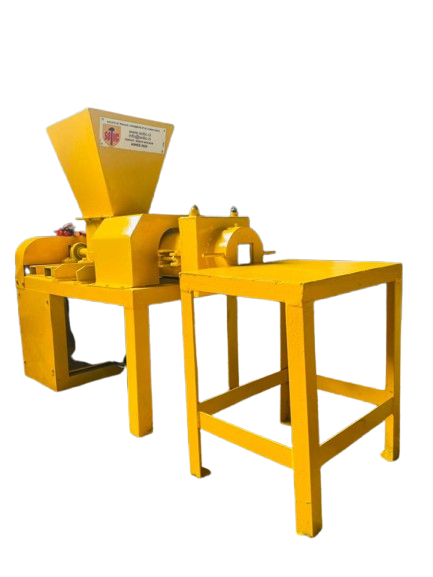
Soap plodder
Continuous extrusion of soap paste into a calibrated bar, the central station of a soap works.
View the sheet
Soap cutting table
Cuts the soap bar into calibrated, regular-weight billets.
View the sheet
Soap stamper
Stamps the soap: final shaping and marking with the maker's brand.
View the sheet
Bleaching vessel
Bleaches oil by adsorption on activated earth, under stirring and heating.
View the sheet
Soap mixer
Homogenises paste, additives and colourings before plodding.
View the sheetArtisanal, semi-industrial and industrial mills
Three scales are found in the field: the village unit handling a few hundred kilogrammes of bunches an hour, the semi-industrial cooperative unit, and the industrial mill running continuously. The stations below are available across all three.
Vertical or horizontal steriliser
Pressure vessel with baskets or cages, associated steam generator, pressure control, automatic purges and statutory safety devices.
- Capacity 0.5 to 5 t bunches/cycle
- Pressure 2.5 to 3 bar
- Duration 60 to 90 min
- Safety valves and interlock
Drum stripper
Rotating barred drum separating fruit from empty bunches by repeated impact, with separate discharge of the two streams.
- Throughput 0.5 to 5 t/h
- Power 5.5 to 22 kW
- Speed adjustable
- Outlets fruit / empty bunches
Heated digester
Vertical vessel with stirring arms and heating by direct steam or jacket, with temperature control and managed filling level.
- Volume by line capacity
- Temperature 95 to 100 °C
- Power 7.5 to 30 kW
- Contact steel suited to the process
Continuous screw press
Reducing-pitch screw in a barred cage, counter-pressure cone adjustable while running, gearbox sized for continuous duty.
- Throughput 0.5 to 5 t fruit/h
- Power 11 to 55 kW
- Adjustment hydraulic or mechanical cone
- Wear replaceable screw and bars
Static clarifier
Heated compartmented settling tank, skimming of the floating oil, sludge draw-off and recovery of residual oil.
- Volume by line
- Temperature 90 to 95 °C
- Heating steam coil
- Outlets oil / sludge
Vacuum oil dryer
Lowers the residual moisture of clarified oil under vacuum, to limit hydrolysis during storage.
- Target moisture < 0.15 %
- Operation under vacuum
- Capacity by line
- Status on study
Palm nut cracker
Cracking by centrifugal impact at adjustable speed, followed by shell-kernel separation in a pneumatic column or a water bath.
- Throughput 200 to 2,000 kg/h
- Power 5.5 to 22 kW
- Separation pneumatic / hydraulic
- Whole kernels to maximise
Palm kernel press
Screw press dedicated to extracting palm kernel oil, with kernel preheating and crude oil filtration.
- Throughput 100 to 800 kg/h
- Power 7.5 to 30 kW
- Preheating recommended
- Cake usable as animal feed
Boiler and steam network
Steam production for sterilisation and digestion, with the option of using fibre and shells as fuel, lagged network and steam traps.
- Fuel fibre, shells or gas
- Network lagged, with traps
- Compliance pressure equipment
- Status on specific study
The stations described above complement the catalogue machines: they are studied, adapted or manufactured on request according to the configuration of your line. The values shown are usual design ranges for this type of equipment; contractual characteristics are established project by project by the SOTIC design office and are not a commitment at this stage.
Four indicators to follow in operation
A mill is run by measurement. These four indicators, recorded regularly, immediately reveal a drift in operation or a setting fault.
Extraction rate
The ratio of oil produced to the mass of bunches processed. Any lasting fall signals screw wear, an unsuitable counter-pressure setting or insufficiently hot digestion.
Oil acidity
It depends above all on the delay between cutting and sterilisation, and on the effectiveness of sterilisation itself. It is an indicator of logistics as much as of process.
Residual oil in the cake
A direct measure of pressing performance. Compared with the proportion of broken nuts, it shows whether the setting should be tightened or eased.
Clarification losses
Sludge carries away recoverable oil. Settling practice and sludge treatment are often a neglected source of yield.
The machine alone is not enough
Every oil palm project is treated as a whole: study, manufacturing, host building, commissioning, training and maintenance.
Sizing
Material and energy balance, process selection, target throughput, investment estimate and operating cost per tonne.
WORKSCivil engineering
Anchor blocks, slabs, effluent drainage, ventilation, separation of clean and dirty areas, electrical supply.
TRAININGLine operation
Operator training in settings, in-process quality checks and emergency stop procedures.
SERVICEMaintenance
Preventive maintenance plan, set of wear parts, corrective work and locally sourced spares.
oil palm: what to check before investing
Yes, provided sterilisation is not sacrificed. It is the step artisanal installations most often cut short, for want of a suitable steam generator — with acidic oil and a poorly prepared mesocarp as the consequences. A properly sized and well-run steriliser, even of small capacity, improves yield and quality at the same time. It is the station on which we advise against economising.
A mill produces its own fuel: press fibre and palm kernel shells have a calorific value which, burned in a boiler, covers a significant share of steam demand. That requires a boiler designed for those fuels, sheltered storage and ash handling. For small capacities, where the boiler investment is disproportionate, a gas-fired steam generator often remains the simplest option to operate.
Mill effluent is heavily loaded with organic matter and must be treated before discharge. The classic route combines cooling ponds, settling, anaerobic then aerobic lagooning, with recovery of residual oil at the head of the chain — an operation profitable in itself. The land needed for the ponds must be reserved when the site is laid out: it is an extremely costly constraint to deal with after the fact.
A mill sized on your bunches
Daily tonnage of bunches, origin of the plantations, average delay between cutting and delivery, energy available: these elements allow us to establish a mill configuration and a realistic yield estimate.