Home › Our equipment › Rubber
From cup lump to a bale that meets the technical specification
Natural rubber is sold on standardised criteria: plasticity retention index, initial plasticity, dirt content, ash, volatile matter. Each of those parameters is built — or destroyed — during coagulation, creping, washing and drying.
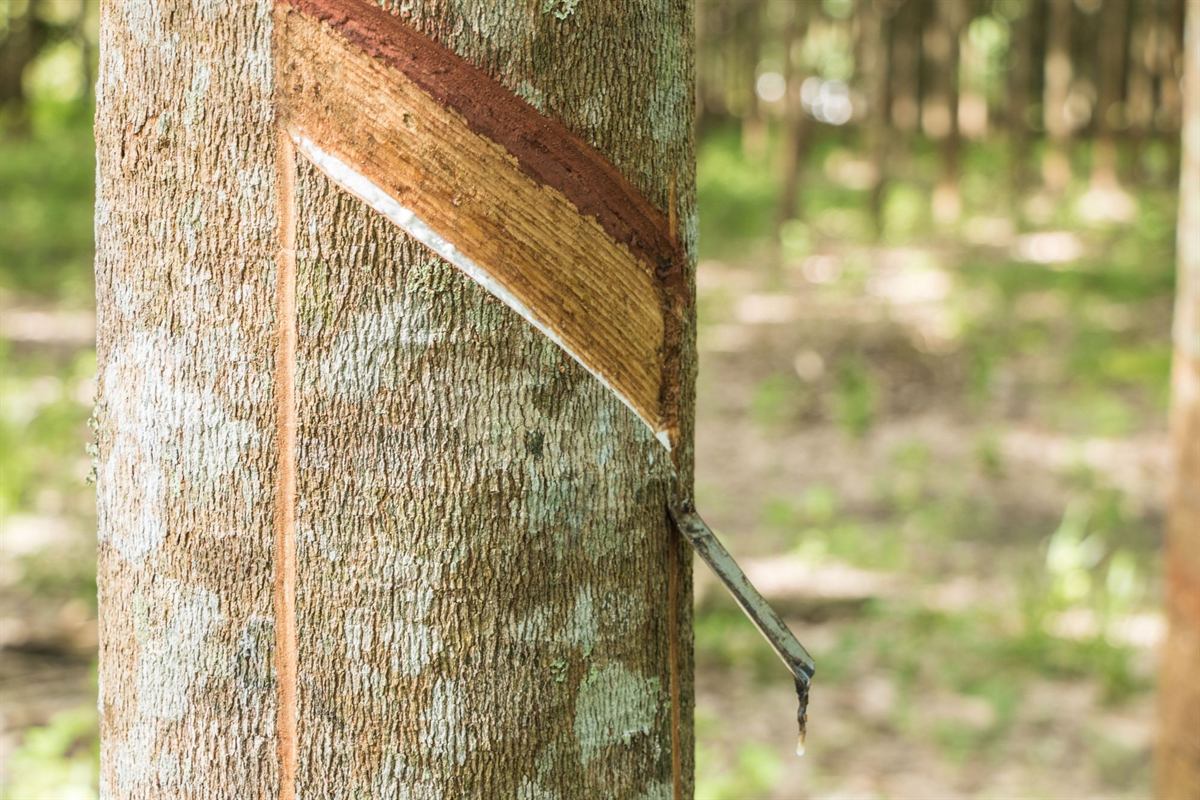
A living material that oxidises from the moment it is tapped
Latex and field coagula are not inert materials. As soon as they leave the tree, enzymatic and oxidative reactions modify the macromolecular structure of the polyisoprene: bonds form between chains, partial cross-linking occurs, hardening develops in storage. These phenomena read directly in the plasticity retention index, a major criterion in the classification of technically specified rubbers.
The other issue is cleanliness. Cup lumps and field coagula arrive laden with soil, sand, bark fragments and plant debris. The dirt content retained in the final specification governs the commercial class of the product. Successive creping and washing serve precisely to open the mass, roll it into thin sheets and carry the mineral particles away against the flow of the water.
Drying, finally, is a thermal trade-off. Too cold or too short, it leaves residual volatile matter that will make weight and properties vary; too hot, it causes thermo-oxidative degradation and a fall in plasticity. Uniform temperature throughout the dryer volume is worth more than a high nominal set point.
Coagulation
Controlled acidification of the latex, pH lowered to around 4.5 to 5.0 depending on practice.
Creping and washing
Successive passes between grooved rolls with counter-current water to remove impurities.
Drying
About 110 to 125 °C, 3 to 4 hours according to granule bed depth and dryer type.
Bales
Standard 33.3 kg format, pressed, wrapped and palletised for shipment.
Reference parameters for processing technically specified rubbers; exact values depend on the process chosen and on the buyer's contractual specification.
Open, wash, granulate, dry, press
The logic of the process is mechanical before it is thermal: the more the mass is opened and washed before the oven, the faster, more uniform and more economical the drying.
Reception and coagulation
Reception of latex or field coagula, cleanliness inspection, and coagulation in tanks by controlled acidification for latex, with control of the thickness of the blocks formed.
Operating parameters
- Coagulation pH ≈ 4.5 to 5.0
- Block thickness by tank arrangement
- Control cleanliness and batch origin
Pre-grinding and cutting
Size reduction of blocks and cup lumps by a knife pre-grinder, to present the creper mills with material of uniform dimension.
Operating parameters
- Power by line capacity
- Particle size made uniform
- Feeding conveyor
Creping and washing
Successive passes between pairs of grooved rolls at differential speeds, with counter-current water spray: the mass is rolled, opened, and mineral impurities are carried away.
Operating parameters
- Number of passes 3 to 6 by cleanliness
- Water partial recycling possible
- Crepe thickness decreasing each pass
Granulation
Cutting of the crepes into granules by a submerged knife granulator, greatly increasing the surface area available for drying.
Operating parameters
- Granule size a few millimetres
- Operation submerged
- Discharge pump or conveyor
Draining and drying
Draining then drying in trolleys in a hot air tunnel, with temperature checked at several points and residence time managed by zone.
Operating parameters
- Temperature 110 to 125 °C
- Duration 3 to 4 h by depth
- Uniformity multi-point checking
Pressing, testing and palletising
Pressing into standard-format bales, sampling for laboratory testing, wrapping, batch marking and palletising for shipment.
Operating parameters
- Bales 33.3 kg standard
- Tests PRI, Po, dirt, ash, volatiles
- Traceability batch marking
The ranges given are orders of magnitude for design drawn from process practice; they are adjusted for each installation once the raw material actually processed has been characterised.
2 machines in the catalogue
Each machine has its own detailed sheet: role in the process chain, operating principle, indicative specifications, installation requirements, maintenance and a direct quotation request.

Line equipment and ancillary stations
The equipment below makes up the stations of a processing line. Their capacities must be balanced against one another: a bottleneck at creping starves the dryer of load and worsens the unit cost of the whole line.
Coagulation tanks
Compartmented tanks in stainless or coated steel, with latex distribution, acid dosing and serum drainage arrangements.
- Capacity by line arrangement
- Materials stainless / resistant coating
- Dosing controlled
- Cleaning organised access and draining
Knife pre-grinder
Rotor with knives and counter-knives in treated steel, robust casing and feed hopper suited to blocks and cup lumps.
- Throughput 0.5 to 3 t/h
- Power 22 to 75 kW
- Knives treated steel, re-sharpenable
- Safety interlocked cover
Grooved creper mill
Pair of cross-grooved rolls driven at differential speeds, rigid frame, nip adjustment and counter-current spray bar.
- Roll width by model
- Power 15 to 55 kW
- Nip adjustable
- Water counter-current spray
Submerged granulator
Cuts crepes into granules under water, limiting heat build-up and easing hydraulic transport to draining.
- Throughput 0.5 to 3 t/h
- Power 22 to 75 kW
- Granules a few millimetres
- Transport hydraulic or conveyor
Trolley dryer
Insulated tunnel with thermal zones, indirect hot air generator, forced ventilation, trolleys with perforated trays and multi-point temperature control.
- Capacity by line sizing
- Temperature 110 to 125 °C
- Zones preheat / dry / cool
- Energy gas or biomass
Baling press
Hydraulic box press with bale ejection, wrapping device and a marking station for batch traceability.
- Format 33.3 kg standard
- Pressure high hydraulic
- Cadence by line
- Finish wrapping and marking
Effluent treatment
Screening, settling and treatment basins for wash water laden with suspended solids and serum, with partial recycling to the spray bars.
- Stages screening, settling, basins
- Recycling partial to washing
- Sludge organised removal
- Compliance per applicable regulation
The stations described above complement the catalogue machines: they are studied, adapted or manufactured on request according to the configuration of your line. The values shown are usual design ranges for this type of equipment; contractual characteristics are established project by project by the SOTIC design office and are not a commitment at this stage.
Steering the criteria of the technical specification
The commercial classification of rubber rests on standardised measurements. Here is how the line acts on each of them.
Plasticity retention index
It reflects the rubber's resistance to thermo-oxidative ageing. It is preserved by limiting coagulum storage times and by controlling drying temperature.
Dirt content
Directly governed by the number of creping passes, the quality of the wash water and the counter-current arrangement. It is the criterion most sensitive to operating discipline.
Volatile matter
The residue of incomplete drying, it makes commercial weight and product properties vary. Consistency of residence time matters more than the set temperature.
Batch uniformity
Mixing origins and coagulum ages produces uneven bales. Reception organisation and batch identification are equipment in their own right.
The machine alone is not enough
Every rubber project is treated as a whole: study, manufacturing, host building, commissioning, training and maintenance.
Sizing
Material and energy balance, process selection, target throughput, investment estimate and operating cost per tonne.
WORKSCivil engineering
Anchor blocks, slabs, effluent drainage, ventilation, separation of clean and dirty areas, electrical supply.
TRAININGLine operation
Operator training in settings, in-process quality checks and emergency stop procedures.
SERVICEMaintenance
Preventive maintenance plan, set of wear parts, corrective work and locally sourced spares.
rubber: what to check before investing
Viability depends less on a technical threshold than on the regularity of coagulum supply and access to the market. Technically, lines of a few hundred kilogrammes an hour exist and work; economically, you must check that the volume processed amortises the dryer, the most capital-intensive item and the most costly to run part-loaded. We establish that break-even point from the real available supply before making any proposal.
By organised recycling. The cleanest wash water, from the last passes, can feed the first passes counter-current. A screening and settling circuit upstream of the recycling loop limits fouling of the spray bars. Fresh water consumption falls sharply, but the installation requires maintenance of the settling tanks that must be planned from the design stage, otherwise it is bypassed in operation.
Yes, provided the two streams are handled separately up to creping: their cleanliness levels and rolling behaviour differ too much to be mixed upstream. In practice that means two distinct reception areas and campaigns organised by material type. Mixing the streams produces batches of intermediate quality, commercially penalised without the cause being identifiable.
A balanced rubber line, from tank to bale
Tell us the tonnage of coagula available, the nature of the material received and the specification your buyer expects: we will propose a line whose stations are sized against one another.