Home › Our equipment › Cereals & Fruit › Pasteuriser
Pasteuriser
Controlled heat treatment: the stage that makes juice safe and stable.
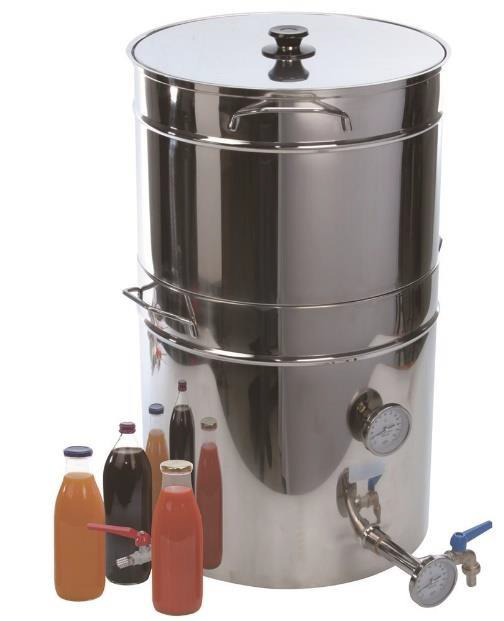
What this machine does
Pasteurisation is what makes a juice marketable beyond immediate consumption. It aims to destroy pathogenic micro-organisms and reduce the spoilage flora, and to inactivate the enzymes responsible for browning and phase separation. It rests on a schedule, that is, a temperature-time pair whose severity depends directly on the acidity of the product: an acidic juice needs a milder treatment than a low-acid product, in which more resistant organisms can develop.
Two mistakes are common. The first is treating without measuring: without a record of the time-temperature pair, there is no proof the schedule was met, and a non-conformity goes unnoticed until an incident. The second is neglecting what comes after: a properly pasteurised juice poured into a badly cleaned container is recontaminated at once. Hot filling and hygiene control of the packaging are an integral part of the process.
See the sector Cereals & FruitAt a glance
- ReferenceFRU-PAS
- SectorCereals & Fruit
- PurposeControlled heat treatment: the stage that makes juice safe and stable.
A detailed PDF data sheet will be available in the document centre once produced.
The parts that do the work
Vessel or exchanger
Heating by jacket or by tubular exchanger according to capacity and product.
Control and recording
Temperature set point, holding time measurement and recording of the pair for traceability.
Agitation
Thermal homogenisation, essential so the whole mass genuinely reaches the schedule.
Transfer to filling
Circuit held hot, allowing containers to be filled hot.
Technical data and configurations
| Characteristic | Indicative value |
|---|---|
| Volume or throughput | according to production capacity |
| Schedule | 85 to 95 °C, duration matched to product acidity |
| Heating | steam, electric or gas according to configuration |
| Control | set point, measurement and recording |
| Product contact materials | AISI 304 stainless steel |
| Agitation | mechanical, for thermal uniformity |
| Cleaning | full draining and access for washing |
| Downstream | hot filling recommended |
These are usual design ranges for this type of machine, intended to guide early thinking. The contractual characteristics of the equipment actually manufactured — throughputs measured at acceptance, absorbed power, real footprint and weight — are established by the SOTIC design office and stated in the technical offer.
Available configurations
- Batch vessel pasteuriser or exchanger for continuous flow.
- Paper or digital recording of the schedule according to market requirements.
- Directly paired with the bottling machine for uninterrupted hot filling.
Installation requirements
- Clean area, separate from fruit reception and preparation stations.
- Energy supply in line with the heating mode chosen.
- Floor drainage with fall and trap, washable, non-slip floor.
- Sited next to the filling station, to avoid any manual transfer of hot juice.
Maintenance and safety at the workstation
A machine lasts as long as its maintenance does. The points below appear in the preventive maintenance plan handed over at acceptance and are covered during operator training.
Preventive maintenance
- Cleaning and disinfection after every production run, to a written, displayed protocol.
- Periodic calibration of the temperature probes: that measurement is what guarantees product safety.
- Check gaskets, the agitator shaft passage and the absence of retention.
- Descale the heating surfaces according to water hardness.
Safety
- Product and surfaces at high temperature: burn risk, protection required.
- Isolation before any internal intervention.
- Never bypass temperature safety devices or schedule alarms.
Before ordering this machine
It is determined product by product, according to acidity and the target flora, and should be validated — ideally by a laboratory — before being fixed as a manufacturing parameter. Taking a schedule from a general document and applying it to a different juice is risky practice: it is precisely the kind of shortcut that leads to a food safety incident.
Pasteurisation is a moderate treatment that preserves sensory qualities but leaves a residual flora: the product generally requires chilled storage and has a limited shelf life. Sterilisation, more severe, allows ambient storage but degrades the product more and requires heavier equipment. For fruit juices, pasteurisation combined with hot filling and good hygiene is the most common route.
Request a quote: Pasteuriser
Tell us the throughput you are aiming for, the material to be processed and the energy available on your site: we come back with a reasoned configuration and a price, rather than a catalogue rate.
- Technical answer: we first check that this machine genuinely matches your need.
- Tailored configuration: size, drive, options and wear parts defined with you.
- Complete pricing: equipment, transport, erection, commissioning and training.
- Next steps: civil works, connections and maintenance where required.
First reply target: 48 working hours.
Other machines in the Cereals & Fruit

Dry hammer mill
Grinds dry products by impact, with particle size set by the screen fitted.

Wet paste mill
Wet grinding of pasty products, with an inclined feed chute.

Parabolic solar dryer
Solar dryer with parabolic reflector: concentrated radiation, no energy consumption.

Gas roaster
Rotating drum roasting with flame control and a mastered treatment curve.