Home › Our equipment › Cassava › Solar drying tunnel
Solar drying tunnel
Sheltered solar drying: drying capacity at no energy cost.
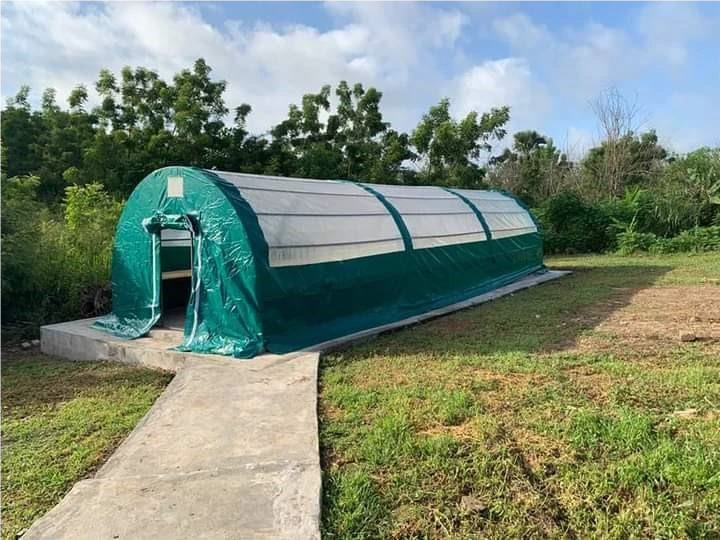
What this machine does
The drying tunnel uses solar radiation inside a closed, ventilated enclosure. The principle is the greenhouse effect applied to drying: radiation passes through the transparent cover, is absorbed by the internal surfaces and by the product, and the heat re-emitted in the long infrared is largely retained by the cover. The internal air warms, its capacity to carry water vapour increases, and controlled ventilation removes the humid air and replaces it with fresh air.
Compared with drying on the ground or on a tarpaulin, still common, the benefit is twofold. Technically, the higher temperature and the air renewal speed up drying kinetics and shorten the period during which the product stays in the moisture range favourable to moulds. In hygiene terms, the closed enclosure protects the food from dust, insects, animals and overnight or rain-shower moisture pick-up — three major causes of batch downgrading.
See the sector CassavaAt a glance
- ReferenceMAN-SER
- SectorCassava
- PurposeSheltered solar drying: drying capacity at no energy cost.
A detailed PDF data sheet will be available in the document centre once produced.
The parts that do the work
Structure and cover
Treated steel arches and film or polycarbonate transmitting solar radiation while retaining the re-emitted infrared.
Drying trays
Racks at working height allowing air to circulate on both faces of the product.
Regulated ventilation
Low and high openings creating natural draught, optionally assisted by extractors for heavy loads.
Access lobby
Protected entrance limiting the entry of insects and dust during handling.
Technical data and configurations
| Characteristic | Indicative value |
|---|---|
| Tray area | according to project sizing |
| Internal temperature | usually 10 to 25 °C above ambient |
| Energy | solar, natural or assisted ventilation |
| Structure | galvanised or corrosion-treated steel |
| Cover | agricultural film or panels according to intended life |
| Products handled | cassava chips, fruit, cereals, spices |
| Capacity | sized on the harvest peak |
| Protection | access lobby and insect-proof closures |
These are usual design ranges for this type of machine, intended to guide early thinking. The contractual characteristics of the equipment actually manufactured — throughputs measured at acceptance, absorbed power, real footprint and weight — are established by the SOTIC design office and stated in the technical offer.
Available configurations
- Several tunnel lengths according to the tray area required.
- Forced ventilation by extractors, possibly powered by a photovoltaic panel.
- Can be paired with a mechanical dryer to guarantee capacity in the wet season.
Installation requirements
- Orientation and siting studied to maximise sunshine and sweeping by the prevailing wind.
- Drained, paved or stabilised ground with perimeter drainage to prevent rising damp.
- Anchoring sized for wind loading: a poorly anchored tunnel is a hazardous structure.
- Handling access passable in the rainy season.
Maintenance and safety at the workstation
A machine lasts as long as its maintenance does. The points below appear in the preventive maintenance plan handed over at acceptance and are covered during operator training.
Preventive maintenance
- Periodic cleaning of the cover: fouling directly reduces radiation transmission.
- Check the film and its fixing points before each season.
- Clean and disinfect the trays between different products.
- Check the insect-proof closures.
Safety
- Do not exceed the admissible load of the trays.
- Ventilate before entering after strong exposure: internal temperature can be high.
- Check wind resistance before the storm season.
Before ordering this machine
It is enough where production is seasonal and falls in the dry period. It is no longer enough as soon as a commercial commitment requires a given volume on a given date, whatever the weather: one rainy week then blocks the whole chain. The robust configuration pairs the tunnel, which does most of the drying at no cost, with a mechanical back-up dryer sized not on annual volume but on the peak in unfavourable conditions.
It depends on the material and on ultraviolet exposure. Agricultural film is replaced periodically; rigid panels last longer for a higher initial outlay. The choice is made on discounted cost, including replacement, not on purchase price alone.
Request a quote: Solar drying tunnel
Tell us the throughput you are aiming for, the material to be processed and the energy available on your site: we come back with a reasoned configuration and a price, rather than a catalogue rate.
- Technical answer: we first check that this machine genuinely matches your need.
- Tailored configuration: size, drive, options and wear parts defined with you.
- Complete pricing: equipment, transport, erection, commissioning and training.
- Next steps: civil works, connections and maintenance where required.
First reply target: 48 working hours.
Other machines in the Cassava
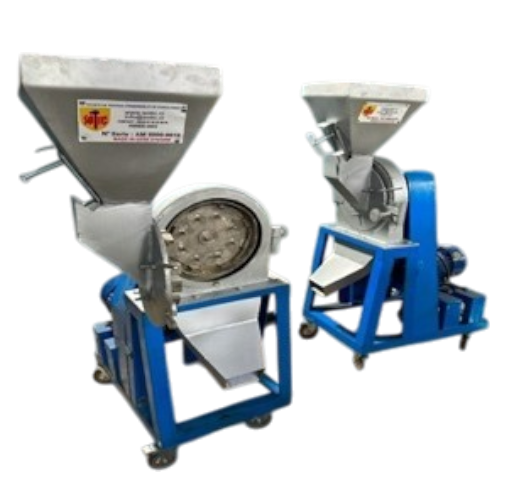
Fixed electric grater
Reduces the root to a fine pulp, as a fixed station with electric drive.
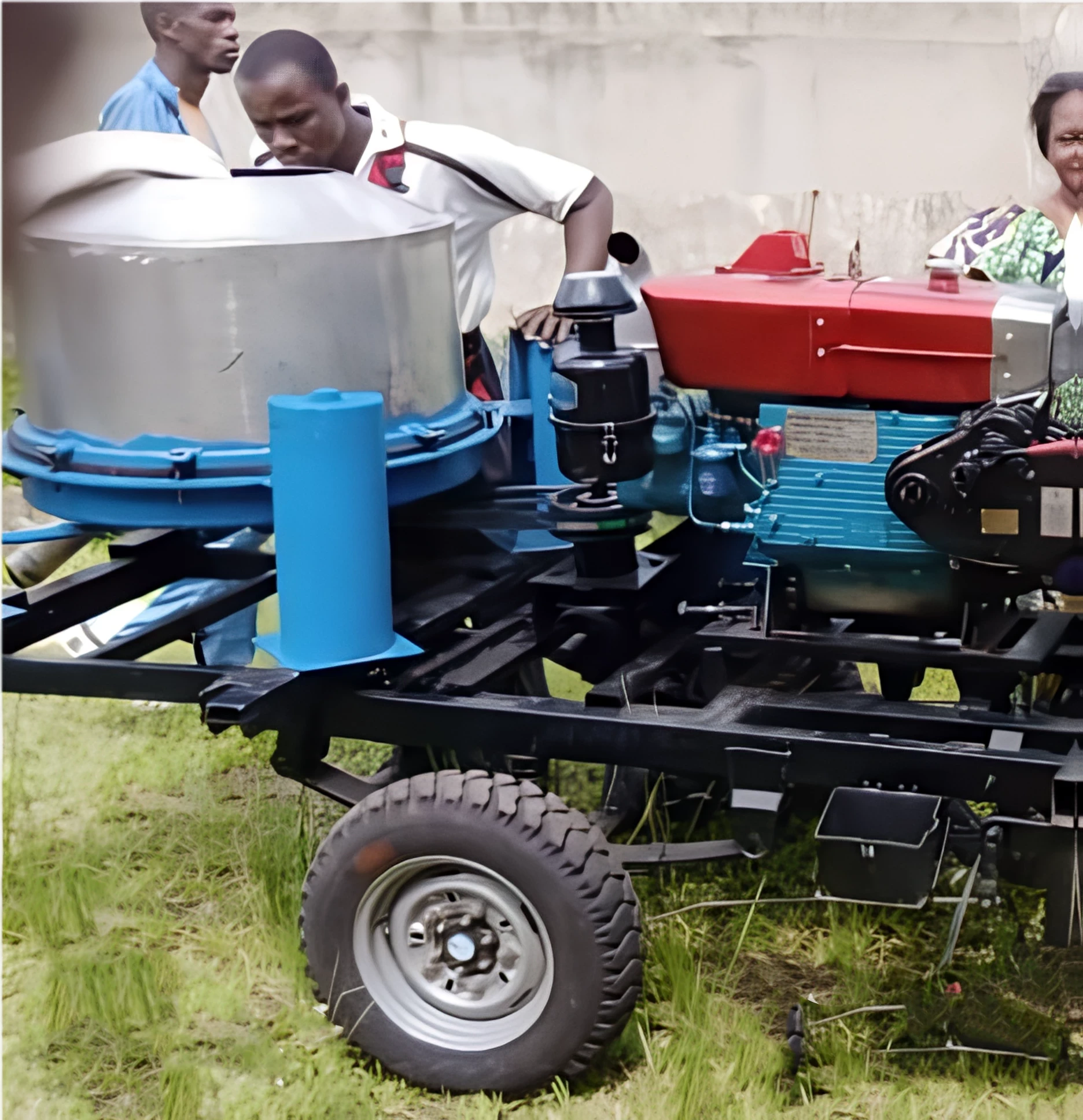
Mobile diesel centrifuge
Mechanical dewatering by centrifugal force, self-powered and movable from site to site.
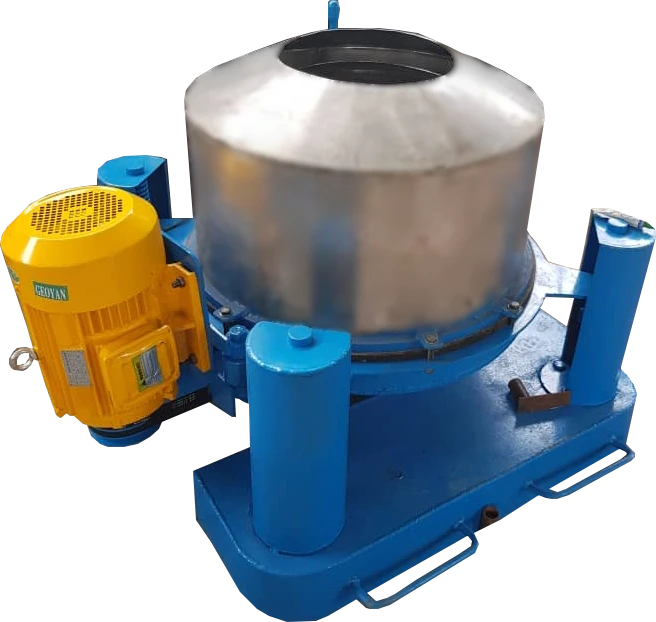
Fixed electric centrifuge
Centrifugal dewatering as a fixed station, for units with a stable electricity supply.

Semolina granulator
Granulates and grades cassava semolina for attiéké and placali.