Home › Our equipment › Cassava › Dehydration dryer
Dehydration dryer
Tray dryer with indirect hot air, for guaranteed capacity whatever the season.

What this machine does
The dehydration dryer provides what solar drying cannot guarantee: a drying capacity independent of the weather and a repeatable schedule. The product is laid on trays in an insulated chamber crossed by a controlled flow of forced hot air. The driving force of drying is the difference between the vapour pressure at the product surface and the partial vapour pressure in the air: it is by acting on temperature and on air renewal that the rate of water removal is controlled.
Heating is indirect, through an exchanger: flue gases never meet the food. This arrangement, which has a cost, is non-negotiable in food processing — direct contact deposits combustion compounds on the product and compromises both its sensory quality and the batch's regulatory compliance. The second critical point is uniformity: a poorly designed chamber quickly dries the trays near the air inlet and leaves those at the back wet, producing a batch whose average moisture is compliant but which is locally at risk.
See the sector CassavaAt a glance
- ReferenceMAN-SDH
- SectorCassava
- PurposeTray dryer with indirect hot air, for guaranteed capacity whatever the season.
A detailed PDF data sheet will be available in the document centre once produced.
The parts that do the work
Insulated chamber
Lagged enclosure limiting heat losses, with removable trays or trolleys.
Indirect hot air generator
Exchanger physically separating combustion gases from the drying air.
Ventilation and recirculation
Circulation fan and partial air recirculation, which sharply reduces energy consumption.
Temperature control
Set point with probes distributed through the chamber, to verify uniformity and not only the average value.
Technical data and configurations
| Characteristic | Indicative value |
|---|---|
| Batch capacity | 200 to 2,000 kg depending on model |
| Adjustable temperature | 40 to 80 °C |
| Heating mode | indirect via exchanger (gas, biomass or electric) |
| Target final moisture | 10 to 12 % for flour and chips |
| Trays | removable frames, area according to model |
| Insulation | lagged panels |
| Control | set point and multi-point probes |
| Product contact materials | AISI 304 stainless steel |
These are usual design ranges for this type of machine, intended to guide early thinking. The contractual characteristics of the equipment actually manufactured — throughputs measured at acceptance, absorbed power, real footprint and weight — are established by the SOTIC design office and stated in the technical offer.
Available configurations
- Loading by individual trays or by complete trolleys.
- Gas, biomass or electric heating according to the energy available on site.
- Recording of the temperature-time curve for batch traceability.
Installation requirements
- Ventilated room with humid air exhausted outside, away from dry product storage areas.
- Energy supply properly sized: drying dominates the unit's energy balance.
- Sufficient clearance in front of the doors for loaded trolleys to pass.
- Washable sloping floor for periodic cleaning of the chamber.
Maintenance and safety at the workstation
A machine lasts as long as its maintenance does. The points below appear in the preventive maintenance plan handed over at acceptance and are covered during operator training.
Preventive maintenance
- Inspection and cleaning of the exchanger: fouling degrades thermal efficiency and can become dangerous.
- Check door sealing and gasket condition, the main source of losses.
- Check the fan and clean the blades, whose fouling unbalances the air flow.
- Periodic calibration of the temperature probes: a drifting probe falsifies the whole schedule.
Safety
- Never bypass the overheat safety devices of the generator.
- Open the doors carefully at the end of a cycle: the outgoing air is hot and saturated.
- Statutory inspection of combustion equipment according to the energy source chosen.
Before ordering this machine
That is the right question to ask before buying. The cost depends on the quantity of water to be evaporated — hence on the effectiveness of upstream pressing —, on dryer efficiency and on the local price of the chosen energy. Two identical units can show very different costs depending on whether the pulp enters at 50 % or 45 % moisture. We calculate this value at the study stage, because it often weighs more heavily than the amortisation of the machine.
Biomass makes sense where agricultural residues are free on site and the operator accepts running a furnace and managing ash. Gas gives the best control and the fastest start-up, at the price of a supply chain. Electricity is reserved for small capacities or finishing stages. The choice turns on the cost of useful energy delivered and on the reliability of local supply, not on the purchase price of the equipment.
Request a quote: Dehydration dryer
Tell us the throughput you are aiming for, the material to be processed and the energy available on your site: we come back with a reasoned configuration and a price, rather than a catalogue rate.
- Technical answer: we first check that this machine genuinely matches your need.
- Tailored configuration: size, drive, options and wear parts defined with you.
- Complete pricing: equipment, transport, erection, commissioning and training.
- Next steps: civil works, connections and maintenance where required.
First reply target: 48 working hours.
Other machines in the Cassava
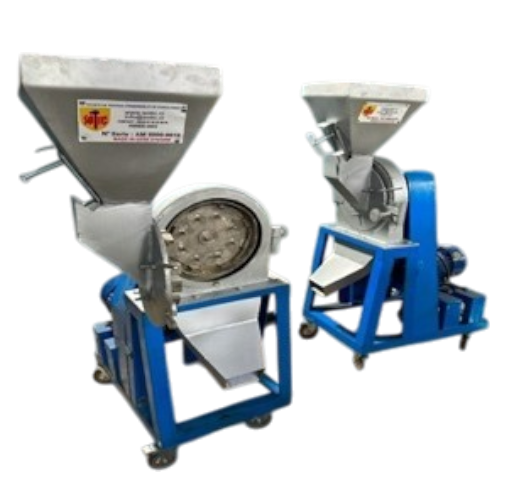
Fixed electric grater
Reduces the root to a fine pulp, as a fixed station with electric drive.
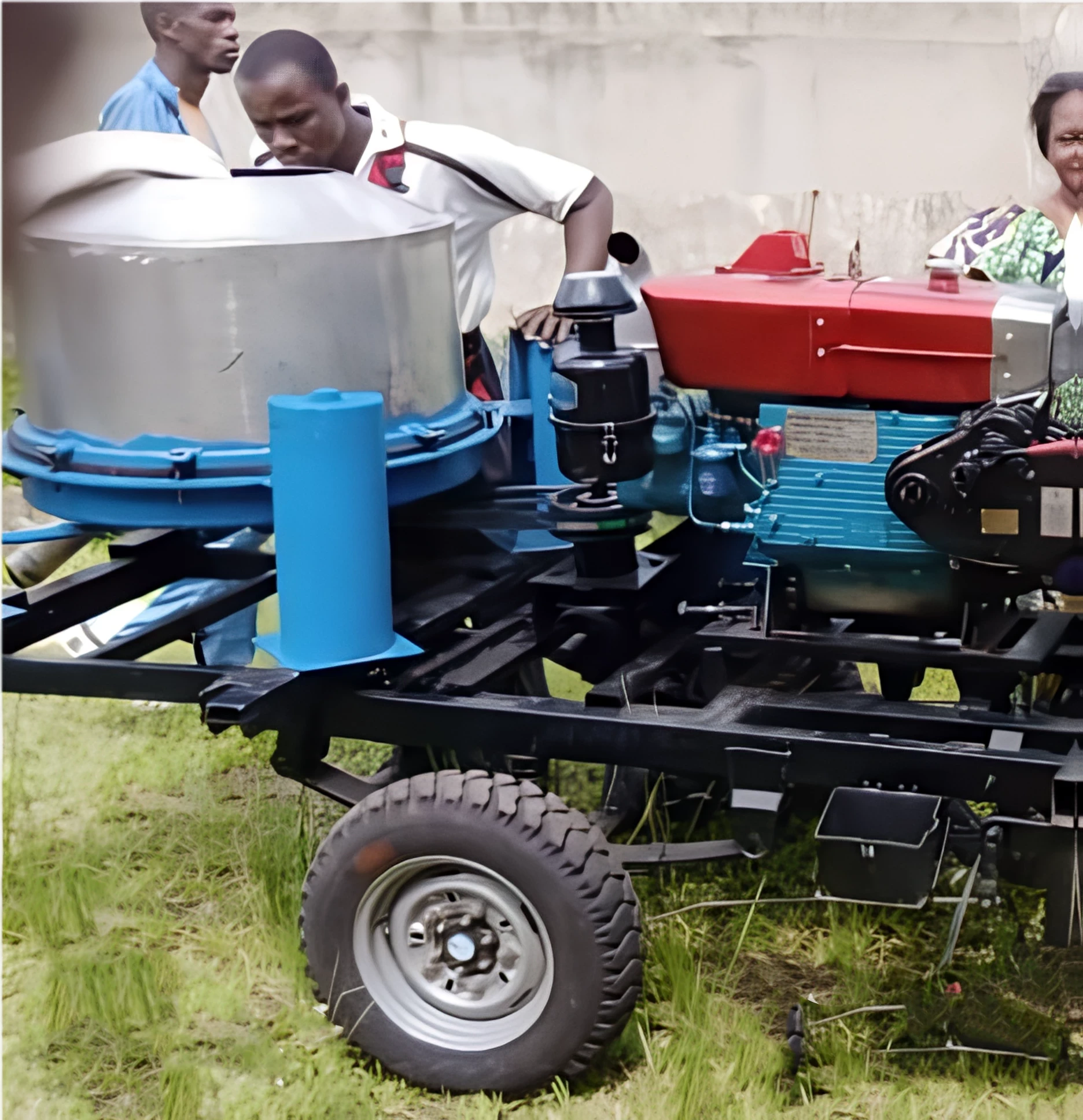
Mobile diesel centrifuge
Mechanical dewatering by centrifugal force, self-powered and movable from site to site.
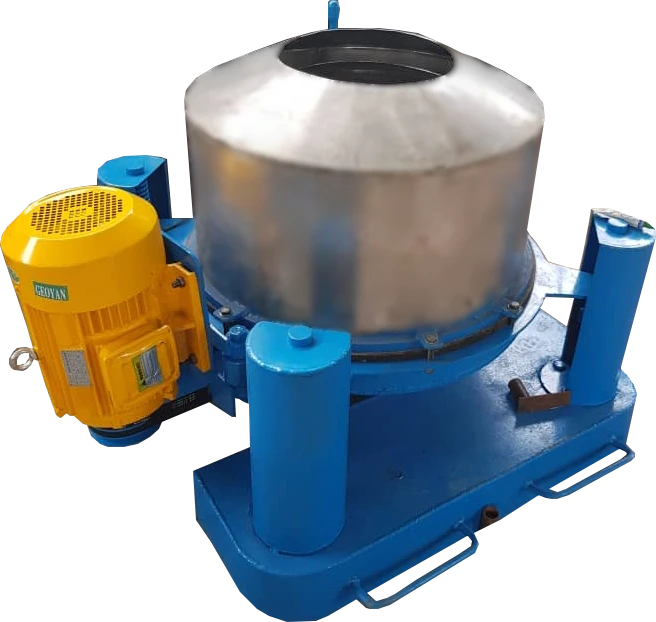
Fixed electric centrifuge
Centrifugal dewatering as a fixed station, for units with a stable electricity supply.

Semolina granulator
Granulates and grades cassava semolina for attiéké and placali.