Home › Our equipment › Oil palm › Soap plodder
Soap plodder
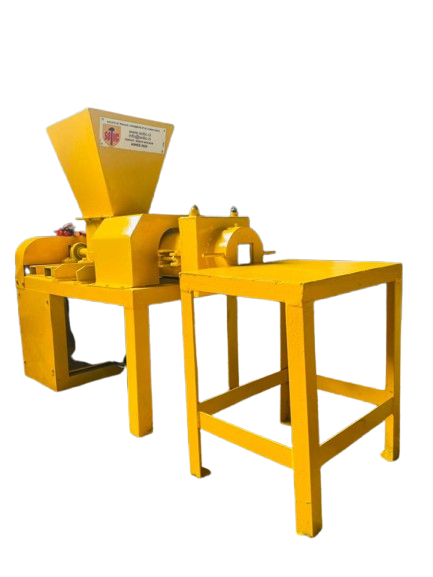
Continuous extrusion of soap paste into a calibrated bar, the central station of a soap works.
What this machine does
The plodder is the heart of an artisanal or semi-industrial soap works. It performs three functions in a single operation: it refines the soap paste by shearing, it makes its composition and water content uniform, and it forms it by extrusion through a die that gives the bar its section. The regularity of that section governs the regularity of the soaps cut downstream, and therefore the weight of each unit sold.
Soap making is a natural extension of an oil mill: it valorises second-grade oils, oils recovered from sludge and fractions less marketable for food use, turning them into an everyday product in strong local demand. Saponification converts triglycerides into fatty acid salts through the action of a strong base; the finishing workshop — plodding, cutting, stamping — gives the product its commercial presentation.
See the sector Oil palmAt a glance
- ReferenceSAV-BOU
- SectorOil palm
- PurposeContinuous extrusion of soap paste into a calibrated bar, the central station of a soap works.
A detailed PDF data sheet will be available in the document centre once produced.
The parts that do the work
Extrusion screw
Conveys and compresses the paste towards the die, with shear that refines and homogenises.
Interchangeable die
Defines the section of the bar, and therefore the format of the soaps obtained after cutting.
Feed hopper
Receives the saponified and dried paste, with regulated feed rate.
Geared motor
High-torque, low-speed drive suited to a stiff, resistant product.
Technical data and configurations
| Characteristic | Indicative value |
|---|---|
| Indicative throughput | 100 to 800 kg/h depending on model |
| Installed power | 3 to 15 kW |
| Dies | interchangeable by soap format |
| Product contact materials | stainless or compatible treated steel |
| Feed | hopper with rate regulation |
| Wear parts | screw and die |
| Mounting | on a frame with adjustable feet |
| Outlet | continuous bar to the cutting table |
These are usual design ranges for this type of machine, intended to guide early thinking. The contractual characteristics of the equipment actually manufactured — throughputs measured at acceptance, absorbed power, real footprint and weight — are established by the SOTIC design office and stated in the technical offer.
Available configurations
- Several die sections according to the formats marketed.
- Single-stage version or twin-stage with vacuum to remove air bubbles.
- Capacities matched to the output of the soap works.
Installation requirements
- Sited in line with the cutting table and the stamper, for a continuous flow.
- Washable floor resistant to soap residues, which make surfaces slippery.
- Protected electrical supply in a humid atmosphere.
- Room ventilation, the paste being able to release alkaline vapours.
Maintenance and safety at the workstation
A machine lasts as long as its maintenance does. The points below appear in the preventive maintenance plan handed over at acceptance and are covered during operator training.
Preventive maintenance
- Full cleaning at the end of production: the paste hardens and jams the screw.
- Check wear of the screw and die, on which the regularity of the section depends.
- Check the geared motor, permanently loaded at high torque.
- Check the condition of contact surfaces, caustic soda attacking unprotected metals.
Safety
- Isolation before any access to the screw: torque is high and the inertia dangerous.
- Skin and eye protection: fresh soap paste is alkaline and caustic.
- Guarded hopper preventing hands from entering.
Before ordering this machine
Yes, by pouring the paste into moulds — a simple, inexpensive method suited to small production. The plodder brings three things moulding does not: weight regularity, higher cadence, and a finer, harder texture, therefore a soap that lasts longer in use, which is a decisive selling point in this market.
Palm oil and palm kernel oil are the classic bases in West Africa, possibly combined with other available fats. Second-grade oils and those recovered from sludge are perfectly suited to this use, which makes soap making a natural outlet for a mill's secondary streams.
Request a quote: Soap plodder
Tell us the throughput you are aiming for, the material to be processed and the energy available on your site: we come back with a reasoned configuration and a price, rather than a catalogue rate.
- Technical answer: we first check that this machine genuinely matches your need.
- Tailored configuration: size, drive, options and wear parts defined with you.
- Complete pricing: equipment, transport, erection, commissioning and training.
- Next steps: civil works, connections and maintenance where required.
First reply target: 48 working hours.
Other machines in the Oil palm

Bunch steriliser
Steam treatment of bunches: the operation that sets the acidity of the entire production.
Bunch stripper
Separates fruit from empty bunches after sterilisation, in a rotating barred drum.
Palm fruit digester
Heated mixing that breaks down the mesocarp and ruptures the oil-bearing cells.
Palm oil press
Mechanical extraction by reducing-pitch screw, with counter-pressure adjustable while running.