Home › Our equipment › Coffee & Cocoa › Cocoa liquor mill
Cocoa liquor mill
Grinds nibs to liquor fineness with controlled heat build-up.
What this machine does
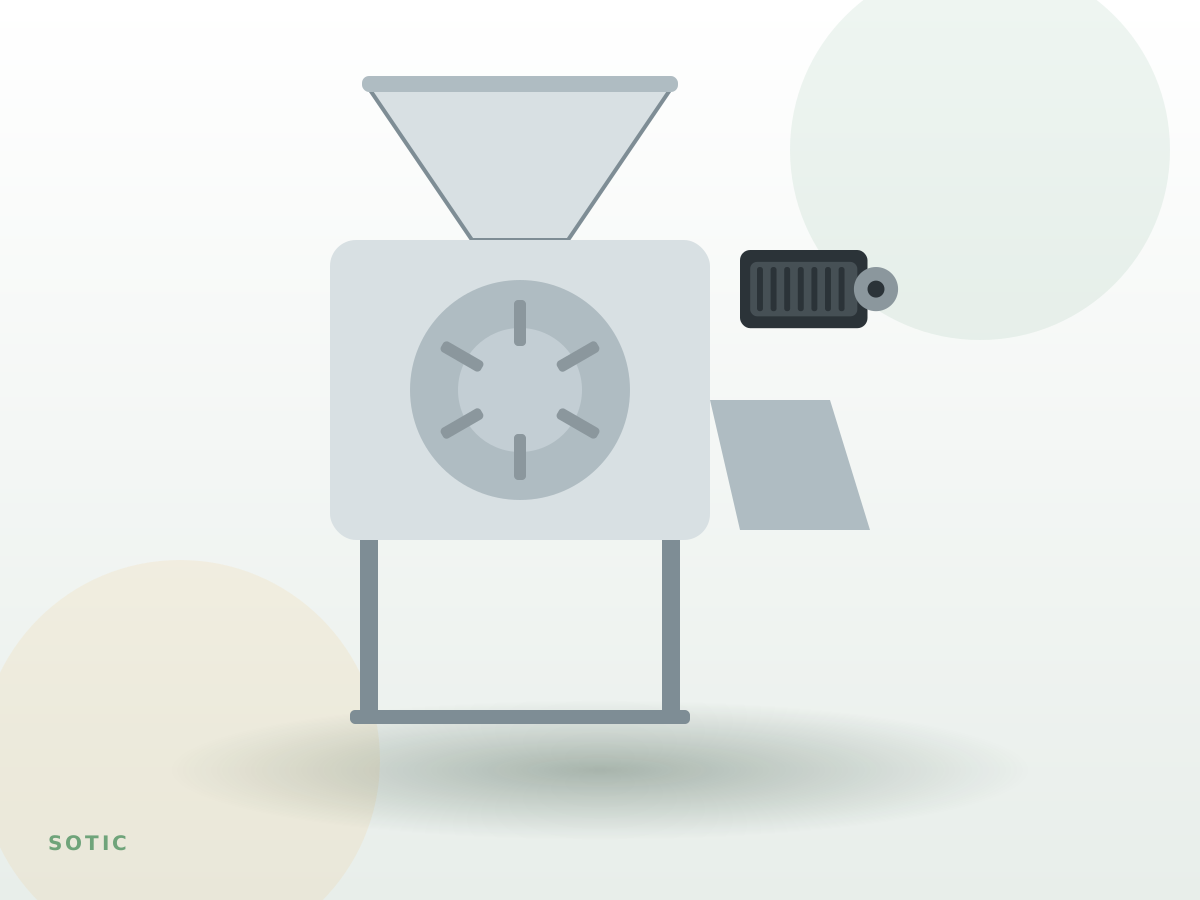
Grinding turns roasted nibs into cocoa liquor, or cocoa mass. The phenomenon is first of all physical: reducing particle size releases the cocoa butter held in the cells, and the material passes from a granular state to a fluid suspension of solid particles in a continuous fat phase. The fineness reached directly determines the mouthfeel of the final product — beyond a certain particle diameter the tongue perceives grit, and the chocolate is judged sandy.
The technical difficulty is thermal. Grinding dissipates energy as heat, and cocoa butter has a low melting point. Excessive heating degrades the aromas built during roasting and complicates later tempering. This is why quality machines have a cooling circuit, and why grinding is done in successive passes rather than in a single brutal operation.
See the sector Coffee & CocoaAt a glance
- ReferenceCC-BRO
- SectorCoffee & Cocoa
- PurposeGrinds nibs to liquor fineness with controlled heat build-up.
A detailed PDF data sheet will be available in the document centre once produced.
The parts that do the work
Successive passes
Progressive reduction of particle size, each pass refining the suspension without concentrating the energy input.
Grinding members
Stones or discs with adjustable clearance, in abrasion-resistant, food-contact compatible materials.
Cooling circuit
Water jacket removing dissipated heat and keeping the liquor within its useful temperature range.
Circulation and recycling
Transfer pump allowing the liquor to be passed again until the target fineness is reached.
Technical data and configurations
| Characteristic | Indicative value |
|---|---|
| Indicative throughput | 50 to 500 kg/h |
| Installed power | 5.5 to 30 kW |
| Target fineness | usually below 30 µm |
| Cooling | water circuit on the jacket |
| Adjustment | clearance of the grinding members |
| Product contact materials | AISI 304 stainless steel |
| Cleaning | draining and access to members without special tooling |
| Operation | batch with recirculation |
These are usual design ranges for this type of machine, intended to guide early thinking. The contractual characteristics of the equipment actually manufactured — throughputs measured at acceptance, absorbed power, real footprint and weight — are established by the SOTIC design office and stated in the technical offer.
Available configurations
- Several capacities according to the volume of liquor produced.
- Two-stage configuration: pre-grinding then fine grinding.
- Paired with a butter press to produce butter and cake.
Installation requirements
- Cooling water supply with guaranteed flow and temperature.
- Temperate room: an over-warm environment complicates thermal control of the liquor.
- Washable floor and a drip tray under the machine.
- Electrical supply sized on installed power.
Maintenance and safety at the workstation
A machine lasts as long as its maintenance does. The points below appear in the preventive maintenance plan handed over at acceptance and are covered during operator training.
Preventive maintenance
- Check the clearance of the grinding members, which degrades through abrasion and reduces fineness.
- Monitor liquor outlet temperature: drift signals a cooling fault or wear.
- Full cleaning between production runs, set liquor being very hard to remove.
- Check the water circuit and descale periodically if the water is hard.
Safety
- Isolate before any opening: the grinding members retain inertia.
- Burn risk from contact with hot liquor.
- Wear suitable gloves during cleaning operations.
Before ordering this machine
It depends on the final product. For chocolate aimed at a demanding market, the usual target is below the tactile perception threshold of the tongue. For liquor destined for powder or for products less sensitive to texture, a coarser fineness is acceptable and saves energy. The sound approach is to set the target from the intended product, then verify fineness by measurement rather than by judgement.
The mill produces liquor, which contains both the fat and the solid particles. Separating butter and cake requires a dedicated hydraulic press working at high pressure. That is an additional investment which only makes sense if a commercial outlet has been identified for both separated products.
Request a quote: Cocoa liquor mill
Tell us the throughput you are aiming for, the material to be processed and the energy available on your site: we come back with a reasoned configuration and a price, rather than a catalogue rate.
- Technical answer: we first check that this machine genuinely matches your need.
- Tailored configuration: size, drive, options and wear parts defined with you.
- Complete pricing: equipment, transport, erection, commissioning and training.
- Next steps: civil works, connections and maintenance where required.
First reply target: 48 working hours.